Conceptual Framework Example: Determinants of Stunting in Children Aged 6–23 Months
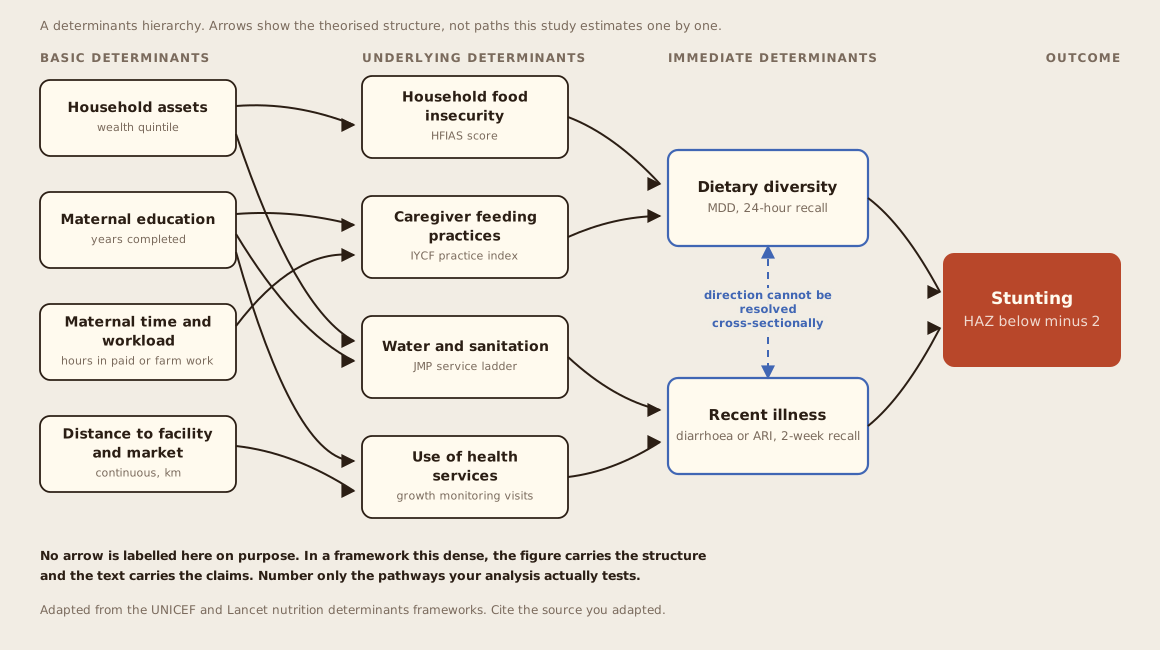
This worked example shows how determinants of stunting among children aged 6–23 months can be organised from household and structural conditions through underlying and immediate determinants to the study outcome. The arrows represent a theorised structure and should be justified using relevant evidence and the study design.
How to read this framework
The framework reads from left to right, moving from distal conditions to the study outcome.
- Basic determinants include household assets, maternal education, maternal time and workload, and distance to facilities and markets.
- Underlying determinants include household food insecurity, caregiver feeding practices, water and sanitation, and use of health services.
- Immediate determinants include dietary diversity and recent illness.
- Stunting, measured as height-for-age Z-score below minus two, is the outcome.
- The dashed two-headed relationship between dietary diversity and recent illness shows that the direction of the relationship cannot be established from cross-sectional data alone.
Variables and measures
| Level | Construct | Example measure |
|---|---|---|
| Basic | Household assets | Wealth quintile |
| Basic | Maternal education | Years completed |
| Basic | Maternal time and workload | Hours in paid or farm work |
| Basic | Distance to facility and market | Continuous, km |
| Underlying | Household food insecurity | HFIAS score |
| Underlying | Caregiver feeding practices | IYCF practice index |
| Underlying | Water and sanitation | JMP service ladder |
| Underlying | Use of health services | Growth monitoring visits |
| Immediate | Dietary diversity | MDD, 24-hour recall |
| Immediate | Recent illness | Diarrhoea or ARI, 2-week recall |
| Outcome | Stunting | HAZ below minus two |
What makes this a useful conceptual framework
- It separates distal, underlying, and immediate determinants.
- It connects each construct to an observable measure.
- It shows the proposed direction of relationships.
- It identifies a relationship whose direction is uncertain.
- It avoids labelling every arrow in a dense framework.
- It allows researchers to retain only the pathways their analysis will examine.
How to adapt it to another study
- Define the study outcome and population.
- Identify determinants supported by the research question and literature.
- Organise determinants by conceptual level.
- Match each construct to the variable or indicator that will measure it.
- Remove relationships that the study will not examine.
- Review whether the study design can support the direction shown by each arrow.
A conceptual framework records the relationships a study proposes to examine. It does not establish that those relationships are causal. Cross-sectional studies can examine associations, although temporal direction may remain uncertain.
Sources
This Methods Bench example is informed by the frameworks below. It is not an official UNICEF or Lancet figure.
- UNICEF Conceptual Framework on Maternal and Child Nutrition, 2020.
- Black RE, Victora CG, Walker SP, et al. Maternal and child undernutrition and overweight in low-income and middle-income countries. The Lancet. 2013;382(9890):427–451.
Continue your research
Three useful next steps, chosen for this topic.