Thematic Analysis in Qualitative Research: A Step-by-Step Guide to Coding and Themes
Learn how to conduct thematic analysis in qualitative research, from familiarising yourself with transcripts and coding data to developing, reviewing and writing strong themes.

Thematic analysis sounds straightforward: read your interviews, code the data and identify themes. In practice, the difficult part often begins after coding. Researchers can end up with dozens or hundreds of sensible codes but still struggle to explain what the data mean. How do codes such as fear of side effects, partner disapproval, hiding contraceptive use and delaying clinic visits become an analysis rather than a list?
The answer is not simply to group similar words together. Thematic analysis requires you to identify patterns of meaning that matter for your research question and then explain what those patterns reveal. That is why a theme should do more than name a topic. It should make an analytical claim.
One important point comes first: thematic analysis is not one single method with one universally correct procedure. Different approaches make different assumptions about coding, researcher subjectivity and how themes are developed. Braun and Clarke’s reflexive thematic analysis, for example, treats analysis as an interpretive and recursive process rather than a mechanical exercise in which themes are objectively “found” inside the data. Their six phases are guidance, not a rigid recipe.
In this guide
What is thematic analysis?
Thematic analysis is a family of approaches for identifying and interpreting patterns of meaning across qualitative data. Those patterns need to matter in relation to the research question.
Suppose you interview postgraduate students about receiving feedback from supervisors. During coding, you might identify unclear comments, fear of asking questions, repeated revisions, waiting for supervisor replies and learning through trial and error. These are useful codes, but they are not necessarily themes.
A theme should say something more substantial about the pattern connecting the data. For example:
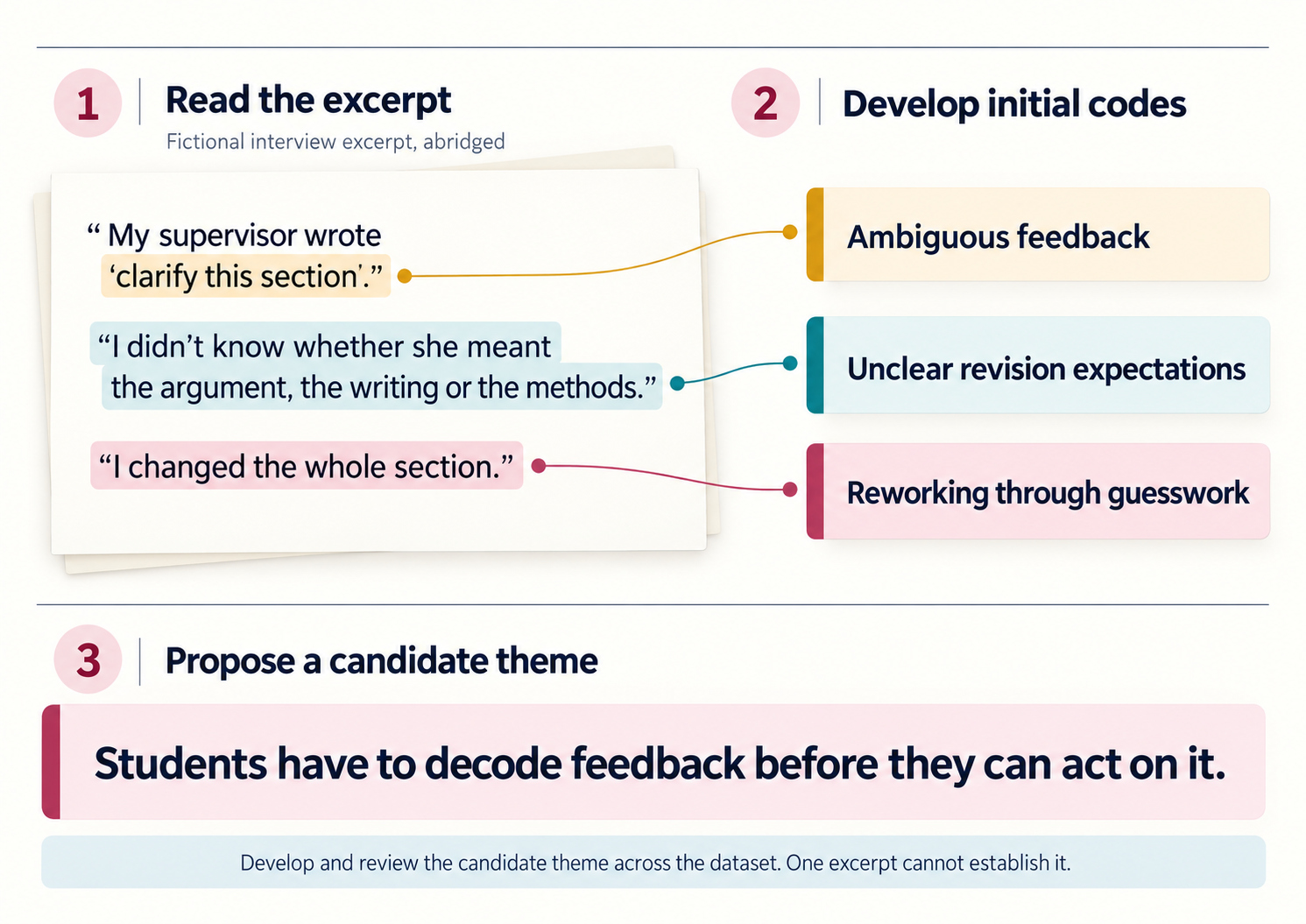
Students have to decode feedback before they can act on it.
That theme brings several observations together around a central analytical idea: feedback is not automatically usable simply because it has been given. Codes capture more specific ideas within segments of data; themes explain a broader pattern organised around a central concept.
Before you code: decide what kind of analysis you are doing
A common problem is that researchers start coding immediately and only later try to work out what methodological approach they used. It is better to make the main analytical choices earlier, because those choices shape what you pay attention to and how you interpret the data.
Are you working inductively or deductively?
An inductive analysis is primarily driven by patterns developed through engagement with the dataset. A deductive analysis is more explicitly guided by an existing question, theory or framework. These are not absolute opposites. A study can be largely deductive while still allowing unexpected patterns to appear.
If you analyse health-worker interviews using the Consolidated Framework for Implementation Research, much of your coding may be deductive because the framework gives you concepts of interest. If your study is exploratory and you deliberately avoid imposing a pre-existing coding frame, the analysis may be more inductive.
The useful question is not, “Which one sounds more qualitative?” It is: what was driving my analytical attention?
Are you coding semantic or latent meaning?
Semantic coding stays relatively close to what participants explicitly say. Latent analysis moves further into underlying assumptions, meanings or social processes.
Consider the statement:
“I don’t tell my partner when I go for the injection because he doesn’t agree with family planning.”
A semantic code might be concealing contraceptive use from partner. A more latent interpretation might be contraceptive decision-making constrained by relationship power.
Both may be legitimate. They answer slightly different analytical questions.
What version of thematic analysis are you using?
If you are using reflexive thematic analysis, say so and use procedures that make sense within that approach. Do not automatically add intercoder agreement, consensus coding or a reliability statistic simply because you think qualitative research requires it.
In reflexive thematic analysis, researcher interpretation is part of the analytical process. Treating coding differences as errors that must be eliminated can conflict with that position. Other approaches to thematic analysis may legitimately use structured codebooks, multiple coders and agreement procedures. The key is methodological coherence.
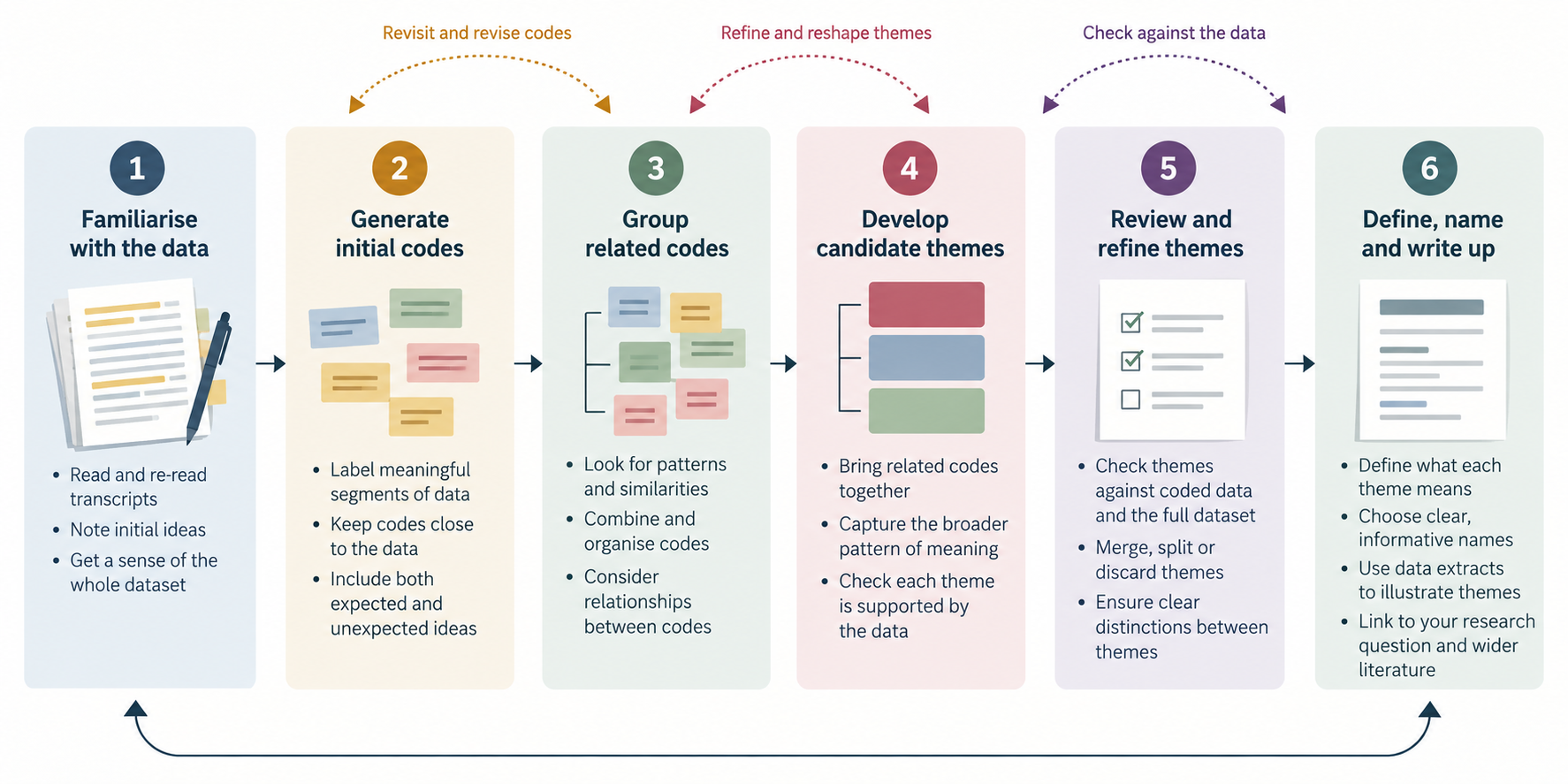
Step 1: Familiarise yourself with the data
Do not begin analysis by immediately attaching labels to every sentence. Read the transcripts, then read them again. Listen to recordings where useful. Notice contradictions, repeated ideas, silences, tensions and unexpected explanations. Record questions that occur to you.
At this stage, you might write an observation such as:
Several participants describe receiving feedback but still not knowing what action to take.
Or:
Participants rarely describe openly refusing partner preferences. They instead describe delay, secrecy and negotiation.
These are not final themes. They are analytical observations that help you begin seeing the dataset as a whole.
The goal of familiarisation is to understand individual excerpts in context rather than treating each quotation as an isolated unit.
Step 2: Generate initial codes
A code identifies something analytically interesting in a segment of data.
Consider this fictional interview excerpt:
“My supervisor wrote ‘clarify this section’. I knew something was wrong, but I didn’t know whether she meant the argument, the writing or the methods. I changed the whole section and then she told me that wasn’t what she meant.”
Possible codes include:
- ambiguous supervisory feedback
- uncertainty about expected revision
- substantial work created by unclear feedback
- interpreting comments through trial and error
Good codes help you retrieve analytically related material later. Weak coding often produces labels that are too broad, such as supervision, feedback or problems. Those labels identify topics but say very little about what is happening.
Compare partner issues with anticipating partner opposition. The second begins to capture a process.
Step 3: Code across the dataset
Do not build a major interpretation from one memorable quotation and then search only for material that confirms it. Work systematically across the dataset.
At the same time, coding does not require every line to receive a code. What matters is that relevant material is examined consistently in relation to the research question.
A segment can receive multiple codes. For example:
“I stopped the pills because I was bleeding. The nurse told me it was normal, but I couldn’t keep going to work like that.”
Possible codes include:
- side effects affecting daily life
- provider reassurance not resolving concern
- discontinuation despite counselling
The same excerpt contributes to several dimensions of the participant’s experience.
Step 4: Move from codes to patterns
This is where thematic analysis becomes analysis.
Lay out your codes and ask which ones appear to describe the same underlying process. Imagine you have:
- ambiguous supervisory comments
- fear of asking for clarification
- guessing what the supervisor means
- repeated revisions
- learning expectations over time
- asking peers to interpret feedback
A weak theme would be Supervisor feedback. That is only the topic.
A stronger candidate might be:
Feedback creates a second task: learning how to interpret the supervisor.
Now the codes are connected by an analytical proposition.
This distinction is critical. Themes should not merely act as filing cabinets.
Step 5: Develop candidate themes
At this stage, ask of each candidate theme:
- Does it have a clear central idea?
- Does the data within the theme belong together?
- Is it meaningfully distinct from the other themes?
- Does it answer the research question?
- Is there enough evidence across the dataset to support it?
Suppose you initially create:
- Theme 1: Poor communication
- Theme 2: Supervisor expectations
- Theme 3: Revision difficulties
On inspection, the three may be different versions of the same underlying issue. You might reorganise them into:
Students first have to decode what “good work” looks like.
Possible subthemes might include interpreting brief comments, learning expectations through revision and using peers to translate feedback.
This produces a more coherent analytical story.
Step 6: Review themes against the data
Go back to the extracts, then go back to the full dataset. Ask whether your theme exaggerates consistency.
Perhaps six participants described avoiding clarification because they feared appearing incompetent, while others actively challenged feedback and negotiated revisions. Do not erase that difference. It may become an important variation within the theme, a subtheme, a boundary condition or evidence that the original theme needs refining.
Strong qualitative analysis is not produced by making everybody sound the same.
Step 7: Define exactly what each theme means
You should be able to finish this sentence:
This theme shows that...
If you cannot, your theme may still be a topic.
Consider:
Theme title: Managing contraception in the shadow of partner opposition
Definition:
This theme shows how women adapted contraceptive decisions in anticipation of partners’ reactions, using secrecy, delay and selective disclosure to preserve access while limiting relationship conflict.
That definition tells the reader what the theme actually argues.
Step 8: Name the theme
A theme title does not need to be theatrical, but it should be informative.
Compare:
Barriers
with:
Access depended on being able to return without being noticed
Or:
Side effects
with:
Side effects became an access problem when switching support was difficult to obtain
The second version makes the analytical contribution visible.
Step 9: Write the analysis, not a quotation catalogue
A weak qualitative findings section often follows this structure:
Participants reported side effects. Participant 3 said... Participant 7 said... Participant 11 said...
The quotations are doing almost all the work.
Instead, start with the analytical claim:
Side effects did not automatically lead to discontinuation. Discontinuation became more likely when women could not obtain timely reassurance, switching or removal support. Several participants initially attempted to continue their method despite bleeding or pain, but persistence became difficult when symptoms interfered with work or daily responsibilities.
The quotation can then illustrate or complicate the claim.
The researcher remains responsible for the analysis.
A worked example: transcript → code → theme
Research question: How do women navigate difficulties while using contraception?
Transcript:
“I wanted to change because the bleeding had continued, but when I went back they told me to wait. I waited another month. Eventually I just stopped going.”
Initial codes:
- attempting to switch
- request for help deferred
- continued side effects
- withdrawal from service after unmet request
Code cluster: Difficulty obtaining method change
Weak candidate theme: Poor side-effect management
Stronger analytical theme:
Continuation depended on whether services could support change, not only whether a method was available.
Why is the final theme stronger? Because it connects the individual experience to a broader mechanism. Availability at initiation is not sufficient. Meaningful access also depends on whether a client can return, switch or discontinue with support when needs change.
That is an analytical finding.
How to report thematic analysis in your Methods section
Avoid:
The data were analysed thematically and themes emerged.
It tells the reader almost nothing.
Instead, explain:
- which approach to thematic analysis you used
- whether coding was primarily inductive, deductive or both
- whether analysis focused mainly on semantic or latent meaning
- who conducted the analysis
- how familiarisation and coding occurred
- how candidate themes were developed and refined
- how reflexivity was addressed where relevant
- what software, if any, supported data management
Software does not perform the conceptual work for you. NVivo, ATLAS.ti, MAXQDA or QualCoder can help organise data, but interpretation remains the analytical task.
Common thematic analysis mistakes
The most common problems are surprisingly consistent: treating interview questions as themes, using broad topics as theme names, describing coding software as though it were the analysis, presenting quotations without sufficient interpretation, hiding contradictory data, mixing methodological approaches without justification, and describing themes as if they simply “emerged” independently of the researcher.
The solution is not more complicated terminology. It is greater analytical clarity.
The final test
Before calling something a theme, ask:
What am I claiming about this pattern?
If the answer is simply “participants talked about X,” you probably still have a topic.
If the answer explains a recurring pattern of meaning and shows why it matters for the research question, you are much closer to a theme.
That is where thematic analysis becomes useful: not when the data have been sorted, but when the analysis helps the reader see something about the phenomenon that was not visible from the quotations alone.
Working through qualitative data? Continue through Analyse & Interpret, revisit the guides on qualitative sample size, saturation and writing qualitative findings, or use Qualitative Analysis Support when you need a second methodological eye on the analysis.
References and further reading
- 1.Braun, V. & Clarke, V. Thematic Analysis resources. https://www.thematicanalysis.net/
- 2.Braun, V. & Clarke, V. Doing reflexive thematic analysis. https://www.thematicanalysis.net/doing-reflexive-ta/
- 3.Braun, V. & Clarke, V. Frequently asked questions. https://www.thematicanalysis.net/faqs/
Work directly with a Methods Bench specialist on this part of your study.
Get qualitative analysis support- How Many Interviews Do You Need for a Qualitative Study? There Is No Magic Number7 min read
- Saturation in Qualitative Research: What It Means and What It Does Not Mean10 min read
- How to Write Qualitative Findings Without Producing a Quote Dump7 min read
Continue your research
Three useful next steps for this topic.
Research notes, once a week
Practical research guidance, useful tools and funding opportunities in your inbox.