What Happens When Participants Take the Camera?
Inside a three-month photovoice study of family planning in urban Uganda
Reviewed by Methods Bench Specialist · 09 August 2026 · 12 min read
Study at a glance
- Setting
- Jinja City and Iganga Municipality, Uganda
- Participants
- 10 women using hormonal contraception
- Approach
- Photovoice
- Duration
- 3 months
- Data collection
- Participant photography + six photovoice meetings
- Discussion
- Adapted SHOWeD technique
- Analysis
- Reflexive thematic analysis
- Paper
- SSM | Qualitative Research in Health, 2026
Family planning can look quite straightforward in routine data.
A facility offers contraception. A woman receives a method. Uptake is recorded.
But contraceptive use continues long after the clinic visit.
Women have to live with the method, manage side effects, negotiate relationships, find care when something goes wrong, travel back to services, deal with stock-outs and decide whether the method still fits what they want.
Our question was how to study that part.
In Jinja City and Iganga Municipality in eastern Uganda, we used photovoice to explore how women accessed, used and navigated family planning services over time. Ten women participated in a three-month process combining photography with repeated group discussions.
This is what the study looked like from the inside.
The research problem
Previous research in the setting had already shown that family planning services were widely available, while important gaps remained in method availability, provider practices and service readiness.
But availability does not necessarily tell us what using those services feels like.
We wanted to understand how women encountered family planning not only at the health facility, but within the everyday environments in which contraceptive decisions actually happened.
That meant asking about experiences:
- at home;
- at work;
- in the community;
- during interactions with health services.
Importantly, those domains were not simply handed to participants as a finished research framework. During training, women were introduced to the broad topic of accessing and using family planning and were encouraged to help define what the research question meant in their own lives. Together, they identified the four areas they wanted to explore.
That was the first methodological shift.
The researchers had a question.
The participants helped determine where to look for the answer.
Why photovoice?
Photovoice is a participatory approach in which participants use photographs and dialogue to document and reflect on their experiences. The study was grounded in an emancipatory research paradigm and drew on established photovoice approaches developed by Wang and Burris and later methodological work.
The appeal was not simply that photographs would make the research more interesting.
We wanted women to have greater control over what entered the research encounter.
A conventional interview begins largely with what the researcher thinks to ask.
Photovoice adds another possibility:
This is what I thought was important enough to show you.
Who participated?
We purposively recruited women aged 15 to 49 using hormonal contraception in Jinja and Iganga, although the final participants were aged 18 to 36. Selection sought variation in contraceptive method, age and residence in slum and non-slum areas.
Five women came from each site.
All ten were using family planning, including injectables, implants, emergency contraception and combined oral contraceptives. They accessed services through a mix of public facilities, hospitals, a community health worker, clinic, drug shop and pharmacy.
Ten sounds like a small number if you imagine ten one-hour interviews.
That was not the design.
The same women participated repeatedly over three months.
Depth came partly from time and repeated engagement, rather than simply increasing the number of participants.
Before anyone took a photograph
Participants first attended an introductory meeting covering the study, consent, potential risks and the boundaries of photography.
They then completed a one-day workshop facilitated by an experienced photographer and the first author. Training covered basic camera use, informed consent, respectful photography and privacy, including how to frame images without identifying people who did not want to be recognised.
Participants received smartphones and were encouraged to take as many photographs as they needed over the following three months.
They documented their own experiences, but could also photograph situations and environments illustrating how women around them navigated family planning. The paper is explicit that some accompanying narratives therefore drew not only on personal experience but also on things participants observed or heard within their social networks.
That distinction matters analytically.
A photograph did not automatically mean:
"This happened to the photographer."
The narrative attached to it established what the image represented.
The study unfolded over time
The group met every two weeks.
Six photovoice meetings were conducted in total.
The first meeting after photography began was used partly to assess whether participants understood the process and were following the ethical guidance.
Subsequent rounds focused on the areas participants had previously identified: home, then workplace, then community, then health services.
The final meeting was deliberately left open so women could introduce photographs or experiences that had not fitted neatly into the earlier themes.
That last step is easy to overlook.
A structured research process can become so orderly that it prevents participants from bringing in the thing the researchers forgot to ask about.
The final unstructured meeting created room for that.
How the study ran
- 1Introductory meeting
- 2Photography + ethics training
- 33 months of photography
- 4Fortnightly discussion meetings
- 56 photovoice meetings
- 6Photo + narrative analysis
- 7Participant / researcher interpretation
Five photographs, then a conversation
For each themed meeting, every participant selected five photographs she considered most relevant.
The photographs were projected to the group and presented by the woman who had taken them.
Discussion used an adapted version of the SHOWeD approach, moving from what was visible in the photograph toward how the situation related to women's family planning experiences, why it mattered and what could potentially be done about it.
The photograph was therefore not the endpoint.
It was a route into a conversation.
And the data became much more than a photo archive.
The study generated narrative material through participant presentations, group discussions, facilitator observations and reflective field notes. Meetings were conducted in Lusoga and Luganda, recorded, transcribed and translated into English.
What the method generated
- Photographs
- Participant presentations
- Group discussions
- Facilitator observations
- Reflective field notes
Interpretation
Photographs, Participant presentations, Group discussions, Facilitator observations, Reflective field notes were brought together into a single interpretation.
The photograph did not speak for itself
This is one of the most useful lessons from the study.
Visual research can create the temptation to treat an image as self-explanatory.
It is not.
A photograph of a locked health facility may show a locked door.
It does not automatically tell us:
- why the participant photographed it;
- whether she was trying to obtain contraception;
- what happened next;
- whether the timing mattered;
- how the experience affected her;
- what she believed the image represented.
That meaning came from the discussion around the photograph.
The paper describes the strength of the method as the interaction between visual prompts and reflective storytelling: photographs grounded discussion in concrete situations, while participant narratives supplied the context needed to interpret them.
That is a better description of photovoice than simply saying:
"We collected photographs and qualitative data."
How was the analysis done?
The recorded discussions were analysed using reflexive thematic analysis following Braun and Clarke's six-phase approach.
The first author repeatedly read the transcripts, generated inductive codes and developed them iteratively into potential subthemes and themes. Themes were discussed and refined with the wider academic research team. QualCoder 3.3 was used to manage the data.
But there was another analytical layer.
After the six photovoice meetings, participants and researchers separately examined the printed photographs, considering their content and context and organizing them into themes.
Researcher-generated and participant-generated interpretations were then compared and integrated.
That is important.
Participation did not stop once participants had generated the data.
They also had a role in making sense of it.
What did the study make visible?
Five themes emerged from the analysis.
Services that do not serve. Women described a gap between nominal access to family planning and practical access, including stock-outs, costs, provider practices, poor infrastructure, inconvenient service hours and difficulties reaching care.
Disputed and constrained decision-making power. Contraceptive decisions could be constrained by partners, providers and age-related stigma.
Living with side effects in exchange for protection. Women described physical and psychological effects and often limited health-system support for managing them.
Community health workers as trusted and flexible providers. CHWs could fill gaps through care that women experienced as more accessible, discreet and flexible.
Quiet acts of reproductive agency. When the formal system did not fit their needs, women found other ways to pursue their reproductive intentions, including covert contraceptive use and alternative practices.
The central finding was not that family planning was unavailable.
It was that availability could coexist with a system that remained poorly aligned with women's needs.
- 01Services that do not serve
- 02Disputed and constrained decision-making power
- 03Living with side effects in exchange for protection
- 04Community health workers as trusted and flexible providers
- 05Quiet acts of reproductive agency
What did the method add?
Several of the barriers themselves were not completely new to family planning research.
That is not the point.
Photovoice situated those problems in the environments in which they were actually negotiated.
Instead of only hearing that opening hours are a barrier, the study could follow what that meant when a woman using contraception covertly left home, arrived at a closed facility and had to account for her absence when she returned.
Instead of only recording that side effects occurred, participants could document the practical consequences of living with those effects.
The published paper argues that the method helped capture experiences prospectively as they unfolded and made women's adaptations to system failures more visible.
For Methods Bench, that is the methodological lesson: the value of a method lies partly in what it changes the researcher's attention toward.
Then the research process started doing something else
Repeated meetings created a forum where participants exchanged experiences and information.
Women accompanied one another to services, linked peers to community health workers and sometimes changed contraceptive behaviour.
The research team was careful not to describe this automatically as the study "empowering" previously powerless women. The paper argues instead that the process may have created a space in which capacities and forms of agency that already existed could be expressed, strengthened or made more visible.
This presents an interesting participatory-research problem.
You begin by trying to observe people's experiences.
Then participation itself creates relationships, knowledge exchange and action.
At that point, the research setting is no longer entirely outside the phenomenon being studied.
That does not invalidate the study.
But it demands reflexivity.
The researchers were part of the method too
The ethical problem was not theoretical
The Methods Bench takeaway
Photovoice was useful here because the research question involved experiences unfolding across places, relationships and time.
But the case also shows why choosing a participatory method cannot end with the claim that photovoice gives participants a voice.
Participants already had voices.
The methodological questions were harder:
- What control did participants have over what entered the study?
- How did images and narratives work together analytically?
- How did repeated participation change relationships among participants?
- How did researcher identity shape interpretation?
- What new risks were created by making research activity visible outside the interview room?
Those questions are what make the method interesting.
The study ultimately showed women navigating a family planning system in which services could be technically available while remaining difficult to use on women's own terms.
But from a research-methods perspective, it showed something else too: giving participants the camera changes more than the data you collect. It changes who decides what is worth looking at, how the research relationship develops and which ethical problems the study has to solve.
Read the original study
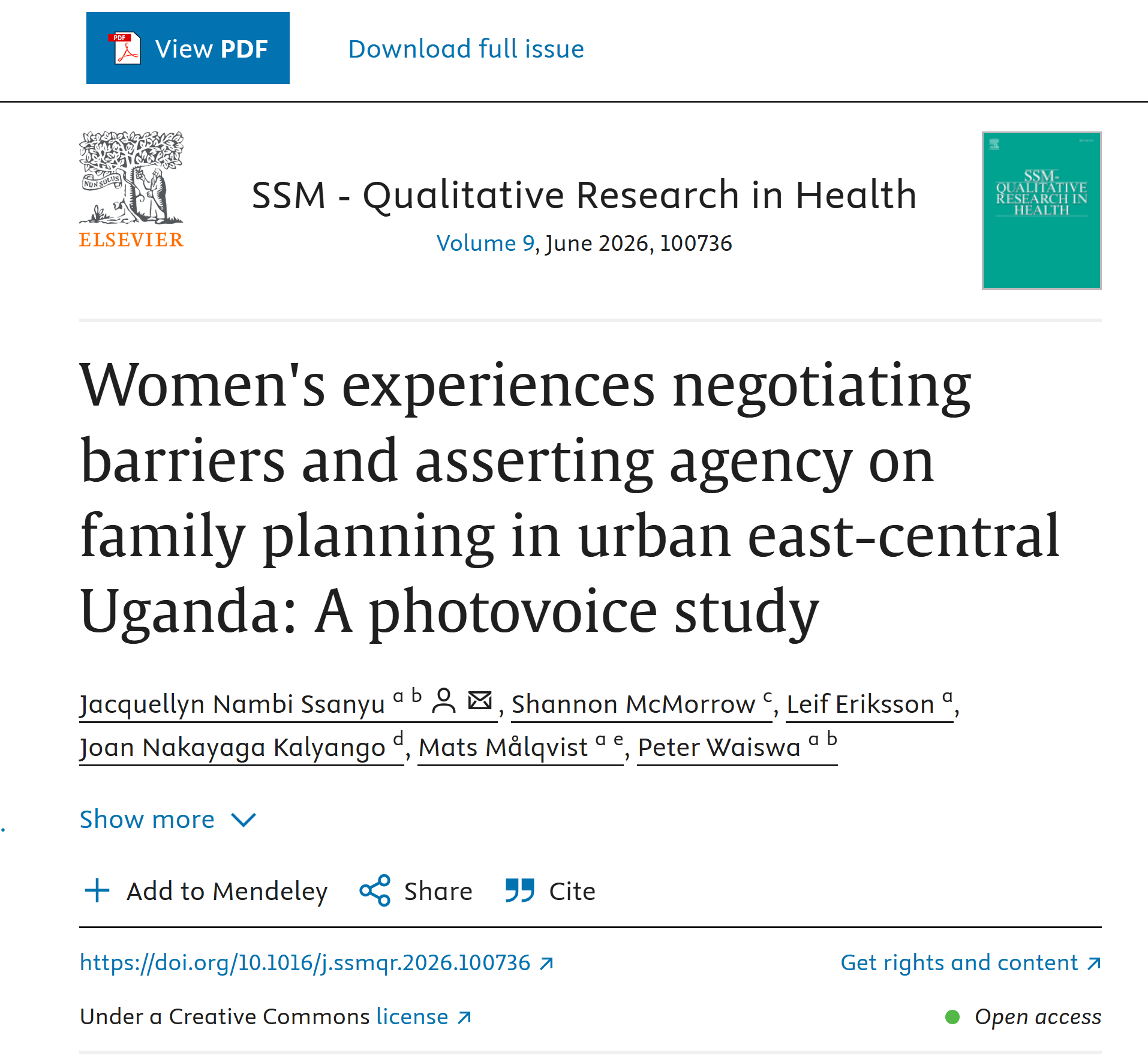
Ssanyu JN, McMorrow S, Eriksson L, Kalyango JN, Målqvist M, Waiswa P. Women's experiences negotiating barriers and asserting agency on family planning in urban east-central Uganda: A photovoice study. SSM | Qualitative Research in Health. 2026;9:100736.
DOI: 10.1016/j.ssmqr.2026.100736
Read the published paperThis Inside Real Research case study is based on a study led by one of the paper's authors.
Related research guides
Continue your research
Three useful next steps, chosen for this topic.