Your themes may still be topics
The difficult step in thematic analysis is not coding. It is moving from what participants discussed to what their accounts mean.
Most researchers who struggle with thematic analysis are not struggling with coding. They have codes, often hundreds of them. The difficulty comes afterwards, when codes are grouped and the groups are given names.
At that point it is easy to produce a list of topics: headings that describe what participants talked about. Topics are useful for organising data. They are not yet findings.
An analytical theme goes further. It says something about what participants' accounts mean: how something works, under what conditions, and with what consequences.
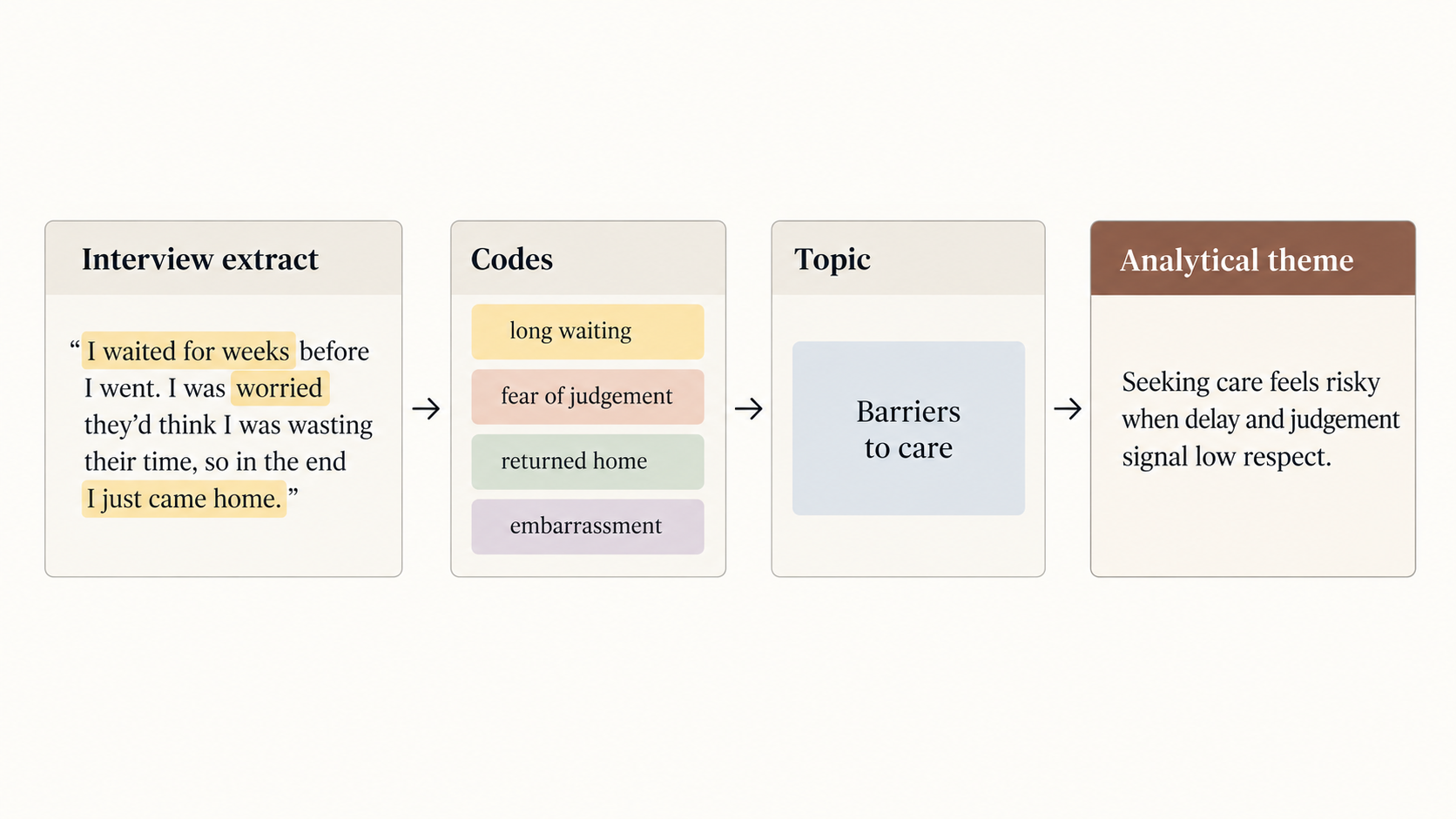
Interview extract → codes → topic → analytical theme
Compare these two ways of reporting the same data:
“Participants talked about X.”
versus
“Across participants' accounts, X appears to operate in this way, under these conditions, and with these consequences.”
The first describes content. The second makes an interpretive claim that the rest of your findings section can support, qualify or complicate.
In the example below, a participant describes returning to a clinic and being told to wait. Codes such as ‘request deferred’ and ‘continued side effects’ could easily be grouped under a topic called “Barriers to care”. That label is accurate, but it only tells the reader what the data is about. The analytical theme explains what is happening: continuation depended on whether services could support change, not only whether a method was available.
The distinction that matters
Before you write up, test each candidate theme against five questions:
If most answers are no, you probably have a well-organised topic. That is a good starting point, and the next step is interpretation.
Go deeper
guideThematic Analysis in Qualitative Research: A Step-by-Step Guide to Coding and ThemesFrom familiarisation and coding to reviewing, defining and writing up themes that carry an argument.Read the guide →guideThematic Analysis Example: From Interview Transcript to Codes and ThemesOne interview excerpt followed through initial codes, a code cluster, a weak candidate theme and a stronger analytical theme.See the worked example →Working through qualitative analysis?
Request qualitative research support
Funding opportunities worth checking
Fogarty Emerging Global Leader Award (K43)Fogarty International Center, NIH · Up to US$100,000/year salary support + up to US$40,000/year research-development support · Deadline: 3 December 2026For: Early-career research scientists at eligible LMIC academic/research institutions Duration: 3–5 years Why it is worth a look: The award is specifically structured around researchers based at eligible LMIC institutions.View on the Fogarty site →Wellcome Early-Career AwardsWellcome · Salary + up to £400,000 research expenses · Deadline: No fixed deadline; apply year-roundFor: Early-career researchers developing independent health-related research programmes Duration: Usually 5 years Why it is worth a look: Broad remit covering health-related research, including methodology, conceptual frameworks, tools and techniques.View on the Wellcome site →Explore the Research Library →
Methods Bench
Make research easier, one useful email at a time.
Practical methods, tools and new Methods Bench resources.