How to Anonymise Interview Transcripts
Reduce identification risks in transcripts and quotations while preserving analytical meaning, using a practical replacement and review process.

A transcript can identify someone without naming them. A rare job title, a small village, an unusual event and a precise date may be enough for a colleague or neighbour to recognise the speaker.
Anonymising qualitative data therefore requires attention to combinations of details, not just a search-and-replace operation on names. The challenge is to reduce disclosure risk while preserving the context needed to understand the research.
In this guide
Begin with the intended use
A restricted analysis file, a published quotation and a dataset shared for reuse have different audiences and risks. Decide what material will be used where, under the consent, ethics approval and data-management arrangements for the study.
Pseudonymisation replaces identifiers but may retain a link to the person. It is not the same as guaranteeing anonymity. Avoid absolute promises when re-identification remains possible.
The UK Data Service. Anonymisation for text data. provides practical guidance on handling direct and indirect identifiers in text. The workflow below is an operational example, not a substitute for applicable institutional or legal requirements.
Identify direct and indirect identifiers
Direct identifiers include names, phone numbers and exact addresses. Indirect identifiers may include specific roles, employers, family relationships, locations and distinctive experiences.
In a fictional transcript, “I am the only laboratory supervisor at Green Hill Clinic, and I joined after the flood in March” contains several clues even if the name has been removed. Ask who could identify the person using local knowledge, not merely whether a stranger could.
Replace details consistently
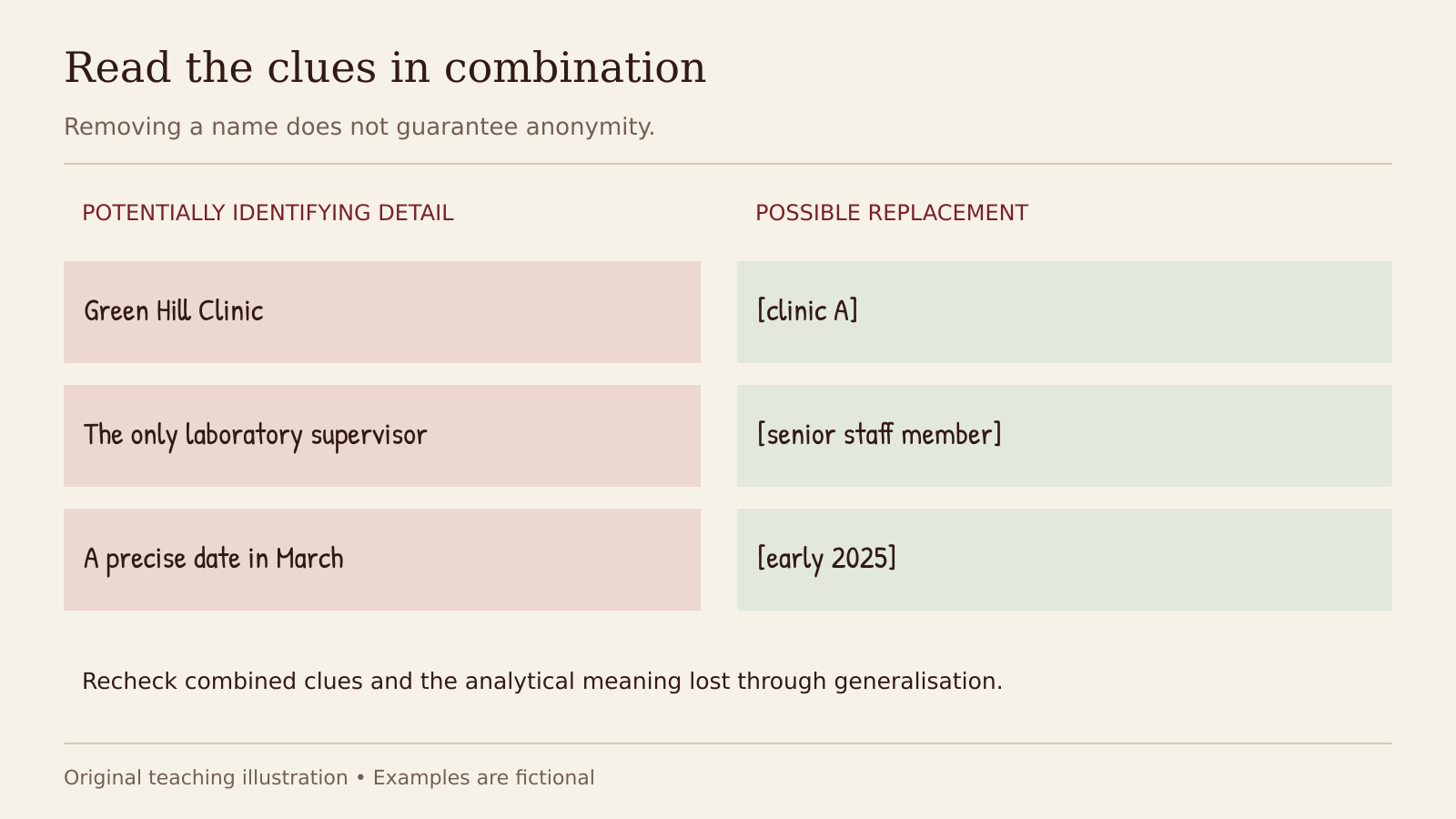
Removing a name does not guarantee anonymity.
Use replacements that preserve relevant meaning where possible. “Green Hill Clinic” might become “[clinic A]”; an exact date might become “[early 2025]”; a very distinctive role might become “[senior staff member]”.
Each change has an analytical cost. Generalising a supervisory role could obscure a power relationship central to the findings. Discuss those trade-offs rather than applying the same level of detail reduction everywhere.
Maintain a restricted replacement log if needed. Store any identity key separately with appropriate access controls. Do not include that key in the folder intended for sharing.
Review combinations, not isolated words
After replacing obvious identifiers, read the account as a whole. Does the remaining combination still point to one person? Compare quotations selected for the same publication: details harmless separately may become identifying when combined across sections.
Also consider third parties mentioned by participants. Consent from the speaker does not automatically authorise disclosure about a colleague, relative or service user.
Protect meaning and quotation integrity
Use brackets or another clearly explained convention for substitutions. Do not silently rewrite a quotation into a statement the participant did not make.
If an extract cannot be made sufficiently safe without destroying its meaning, consider omitting it or reporting the analytical point without a direct quotation. Do not present a composite or paraphrase as a verbatim quotation. Any such approach requires transparent explanation and methodological and ethical justification.
Check the files beyond the transcript text
File names, document properties, comments, tracked changes and audio can contain identifiers. Review the actual export intended for sharing, not only the working document. Use approved storage and transcription arrangements; uploading raw interviews to an unapproved service can create a separate disclosure problem.
Before publication, conduct a final quotation-level review against the study’s consent and risk assessment. Keep a record of difficult decisions and seek the appropriate data-protection or ethics advice when uncertain.
The aim is not to make participants unrecognisable at any analytical cost. It is to make deliberate, defensible decisions about what can safely be disclosed. See the research ethics collection for related planning questions.
Continue your research
Three useful next steps for this topic.
Research notes, once a week
Practical research guidance, useful tools and funding opportunities in your inbox.