Data Extraction Template for a Literature Review
Design and pilot a review extraction sheet with clear definitions, source locations and separate fields for reported facts and interpretation.
A data extraction sheet should do more than store information. It should capture the information needed to answer your review question, in a form that can be checked and compared.
The common failure is collecting everything that is easy to copy—author, year, country, sample size—and discovering later that the important distinction was never recorded. A review of appointment reminders, for example, needs to know what the reminder actually contained, when it was sent and what the comparison group received.
In this guide
Work backwards from the intended synthesis
Write the questions your results section must answer. In a fictional reminder review, these might be: Which strategies were used? In which settings? Compared with what? How was attendance defined? What were the estimated effects and their uncertainty?
Each question needs corresponding extraction fields. If a field has no planned analytical purpose, ask whether it belongs in the core sheet or in supplementary notes.
Define fields before filling them
“Intervention details” is not a sufficiently clear field for a team review. Split it into content, delivery channel, timing, frequency, provider and any tailoring. Add a small coding guide explaining what each field means.
| Field | Fictional extracted entry | Why it matters |
|---|---|---|
| Study ID | REM-014 | Links multiple reports from one study |
| Report ID | REM-014-A | Identifies this particular publication |
| Reminder timing | 24 hours before scheduled visit | Distinguishes the delivered strategy |
| Comparison | Usual booking card; no automated reminder | Makes the contrast explicit |
| Attendance definition | Visit completed within seven days of scheduled date | Prevents treating unlike outcomes as identical |
| Result location | Table 2, page 6 | Enables verification |
Preserve units, denominators and time points. “Attendance: 70” could mean 70 people, 70%, or a score. Ambiguity acquired during extraction becomes uncertainty during synthesis.
Separate what the paper says from what you conclude
Use distinct fields for the authors’ description, your standardised category and your interpretation. If authors call an intervention “community based” but all delivery occurred in a hospital, record the original wording and explain your classification.
Use “not reported”, “not applicable” and “unclear” consistently. They are different states. A blank cell should not force the next reviewer to guess whether something was absent, overlooked or awaiting extraction.
Pilot on deliberately different studies
Test the sheet on a few studies that vary in design, reporting quality or intervention type. An easy, well-reported paper will not expose the problems an incomplete report will.
Ask whether two reviewers interpret fields similarly, whether essential information has somewhere to go, and whether the sheet creates unnecessary copying. Revise the form, version it and revisit earlier extractions affected by the revision. The Cochrane Handbook, Chapter 5: Collecting data. provides detailed guidance on planning and managing data collection for intervention reviews.
Protect the study structure
A study may have several arms, outcomes and follow-up periods. Cramming them into one cell can create errors when transferring data into analysis. Use linked outcome or comparison tables when necessary, with stable IDs connecting them to the study record.
Decide in advance which results are needed and how competing reports will be handled. Never select the most favourable estimate simply because it makes the synthesis cleaner.
Finish with a traceability check
Select one number in your draft synthesis. Can you move backwards from the statement to the extraction field, report and exact source location? Then move forwards: can another reviewer reproduce the same interpretation?
Copy this extraction structure
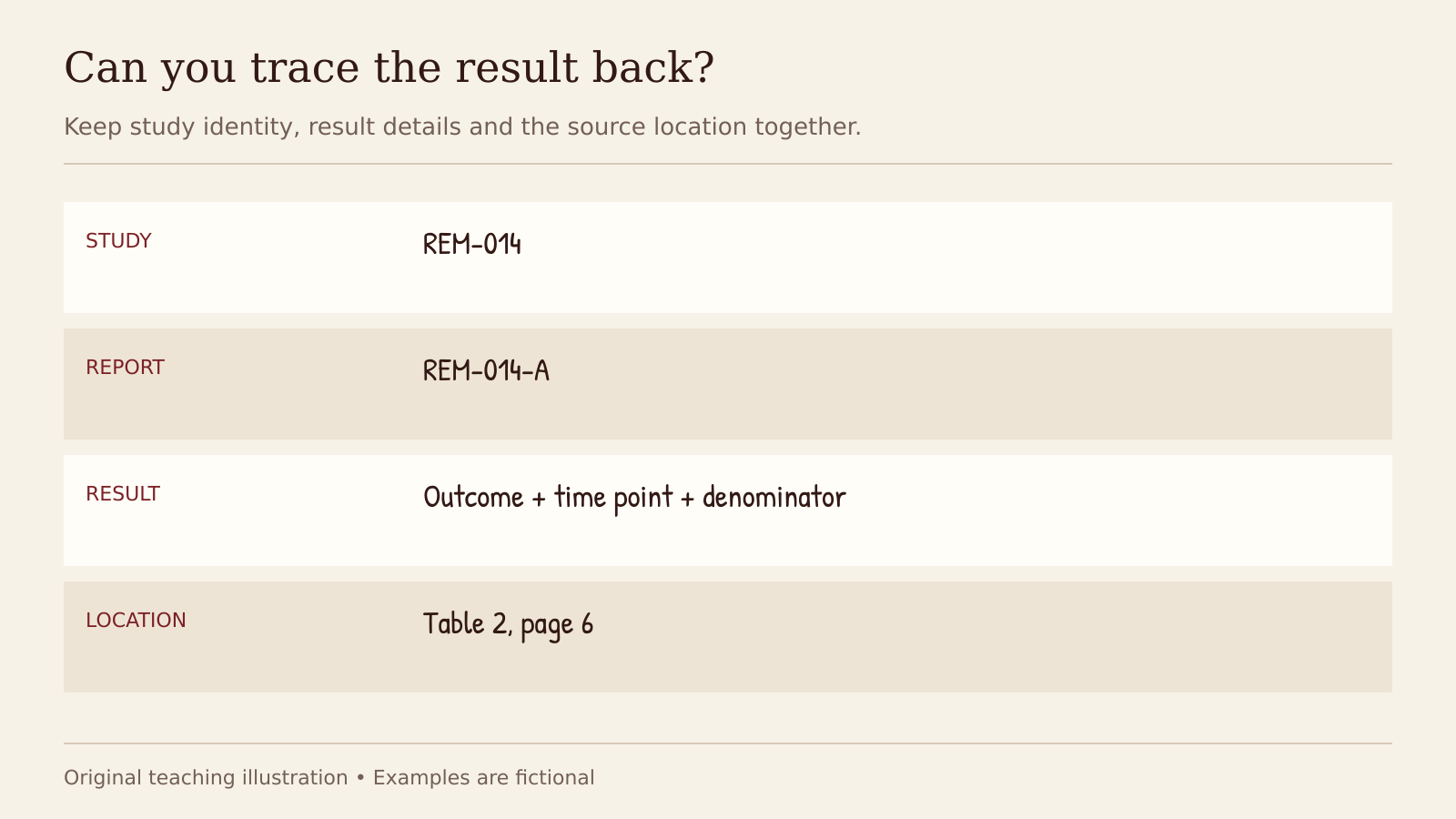
Keep study identity, result details and the source location together.
Start with these linked tables and adapt them to the review question. This is a starter structure, not a complete extraction form for every review.
| Table | Minimum fields to define |
|---|---|
| Study | study_id, design, setting, recruitment period, population, sample size |
| Report | report_id, study_id, citation, publication type |
| Intervention/comparison | study_id, arm_id, components, timing, comparator details |
| Result | study_id, arm or contrast, outcome definition, time point, denominator, estimate, uncertainty, source location |
Use a field guide alongside these tables. In particular, specify how you will represent missing information and multiple results, so the structure preserves rather than erases the study design.
That two-way check is more useful than a beautifully formatted sheet with uncertain contents. Once extraction is stable, use the literature review and synthesis collection to plan how the evidence will be compared rather than merely listed.
Continue your research
Three useful next steps for this topic.
Research notes, once a week
Practical research guidance, useful tools and funding opportunities in your inbox.