Framework Analysis Matrix: A Worked Qualitative Example
Chart qualitative cases in a framework matrix while retaining context, source references and the difference between summary and interpretation.

A framework matrix can make a large qualitative dataset easier to compare. Cases occupy one dimension and analytical categories the other, allowing you to look across participants and within a single account.
Its value is not that interviews become tidy boxes. Its value is that the boxes support systematic comparison while remaining connected to the original material. If the context disappears, the matrix has become a filing system rather than an analytical tool.
In this guide
Decide whether the approach fits
The Framework Method described by Gale et al. Using the framework method for analysis of qualitative data in multidisciplinary health research. 2013. is particularly useful for some applied, team-based qualitative studies. It is not a universal replacement for other forms of analysis.
Before building the matrix, check that your research question, data and methodological position support case-by-category comparison. Highly varied materials or an analysis centred on narrative sequence may require a different approach or a carefully adapted structure.
Define the case
A row might represent a participant, organisation, household or another relevant unit. Choose deliberately. If several participants speak about the same organisation, one row per person and one row per organisation answer different questions.
In a fictional study of appointment systems, the team uses one row per clinic staff interview. Columns include booking processes, workload, communication with users and responses to missed visits.
These categories are an analytical starting point, not findings. They may evolve as the team becomes familiar with the data.
Chart meaning rather than fragments
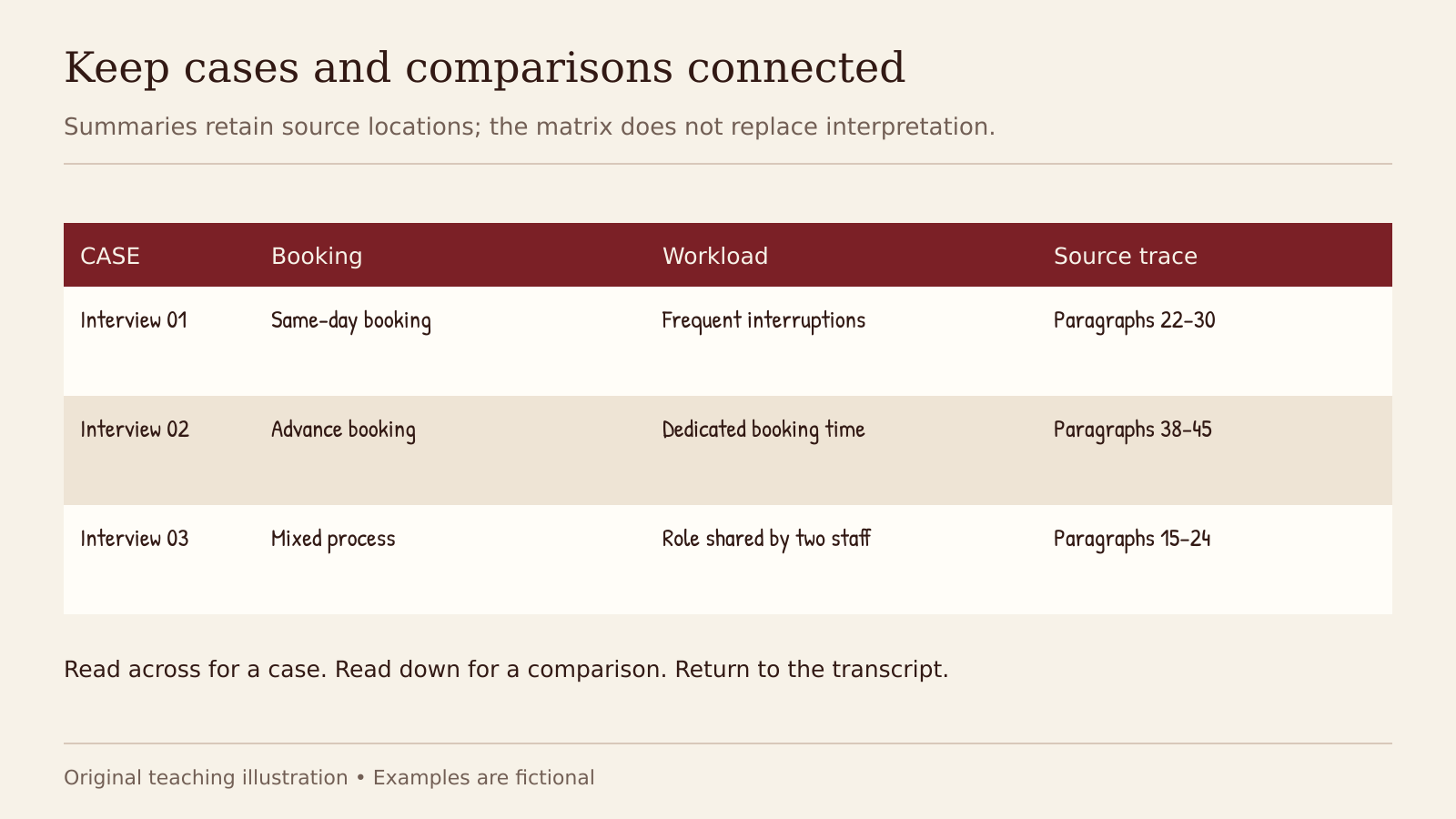
Summaries retain source locations; the matrix does not replace interpretation.
An unhelpful cell says “staff shortage”. A stronger cell records: “One staff member handles booking and registration; interruptions during busy mornings delay confirming appointments. Interview 04, paragraphs 38–45.”
The second version preserves a relationship, context and location. Include selected short extracts where they add meaning, but do not paste entire transcripts into cells. The matrix should support navigation and comparison, not duplicate the source files.
Keep reported experience separate from your interpretation. A participant’s explanation that staffing causes delays is evidence about their account; establishing a system-wide causal effect would require more.
Compare in both directions
Read across a row to understand how one case fits together. A clinic may have efficient booking but unreliable follow-up communication. Reading isolated columns could hide that combination.
Then read down a column to compare cases. Does the same problem occur in different settings? Are there exceptions? Are similar labels concealing different processes?
Write analytic memos about these comparisons. The matrix does not generate an explanation by itself.
Preserve absence and uncertainty
Distinguish “not discussed”, “explicitly absent” and “unclear”. An empty cell does not prove that a participant lacked the experience. The interviewer may not have asked, the topic may not have arisen or the participant may have chosen not to elaborate.
If the coding framework changes, document the revision and revisit affected cases. Otherwise, early interviews may be charted under a different logic from later interviews without anyone noticing.
Keep team work coherent
Agree on how much detail belongs in a cell, how source references are recorded and how interpretive disagreements are discussed. Reviewing a small shared set can expose incompatible assumptions about categories before they spread through the dataset.
Do not mistake a completed matrix for a completed analysis. Before writing a finding, return to the relevant accounts, inspect variation and ask what the comparison explains.
The strongest matrix is a bridge between depth and comparison. It should make the original accounts easier to interrogate, not easier to forget. Continue with the qualitative research collection for guidance on developing and reporting interpretations.
Continue your research
Three useful next steps for this topic.
Research notes, once a week
Practical research guidance, useful tools and funding opportunities in your inbox.