Intervention Adaptation Log: A FRAME-informed Template
Document what changed in an intervention, why, when and by whom, then assess implications for core functions and implementation.
An intervention rarely moves from a protocol into routine delivery unchanged. Staff adjust schedules, materials, roles and delivery channels in response to practical conditions. Some changes preserve the intervention’s purpose. Others may weaken or alter it.
Calling every change a fidelity failure is unhelpful. Calling every change an improvement is equally unhelpful. An adaptation log creates the evidence needed to examine what happened.
In this guide
Define what matters before delivery
Describe the intervention’s intended functions, components and delivery requirements. Where possible, distinguish a core function from the particular form used to deliver it.
For example, the function might be to give participants a timely opportunity to resolve questions before an appointment. The original form might be an in-person orientation. Replacing it with a phone call could preserve that function—or fail if participants cannot receive calls privately or reliably.
That judgement requires evidence. It cannot be settled by declaring the new channel more convenient.
Record changes when they happen
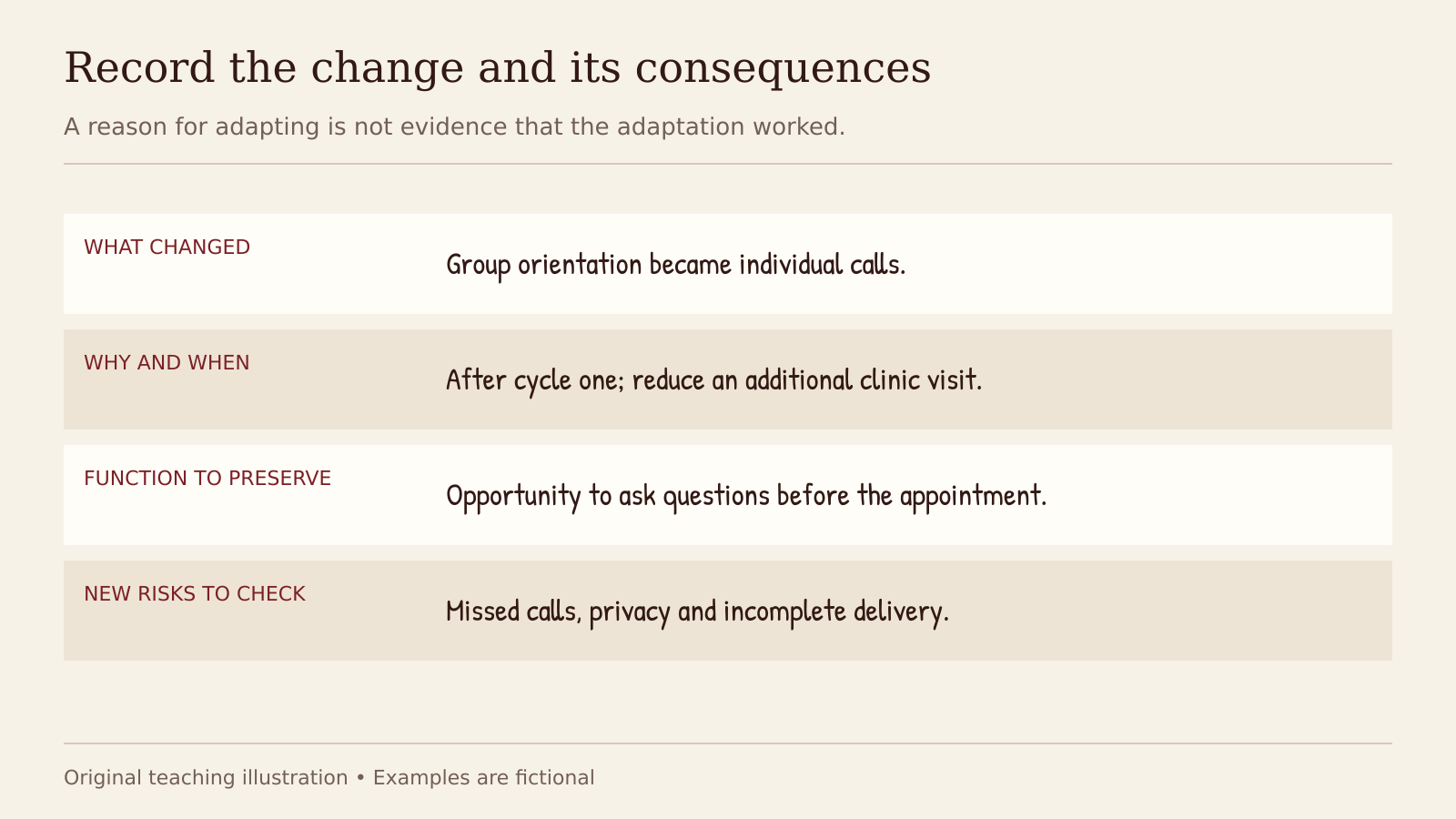
A reason for adapting is not evidence that the adaptation worked.
Wiltsey Stirman, Baumann and Miller. The FRAME: reporting adaptations and modifications to evidence-based interventions. 2019. provides a structure for describing adaptations and modifications. A practical log can record the change, timing, decision-maker, reason, target level, whether it was planned and its relationship to fidelity.
In a fictional programme:
| Field | Example entry |
|---|---|
| Change | Orientation moved from clinic groups to individual calls |
| Timing | After the first delivery cycle |
| Reason | Participants reported difficulty attending an additional clinic visit |
| Decision | Agreed by implementation team with documented stakeholder input |
| Intended function | Preserve opportunity for questions before the appointment |
| Concern to monitor | Missed calls and reduced privacy |
| Evidence needed | Reach, completion, participant experience and content delivered |
This records a hypothesis about preserving function, not a demonstrated success.
Separate the change from its consequences
“We shortened training because staff were busy” describes a decision and rationale. It does not show whether participants acquired the intended skills or whether delivery quality changed.
Link the adaptation log to process data where possible: attendance, observation, delivery records, interviews or other relevant evidence. Record intended and unintended consequences separately.
Avoid judging the adaptation solely by the final programme outcome. Many other factors may have influenced that outcome, and a favourable result does not prove every modification was harmless.
Notice changes to implementation support
Teams may change supervision frequency, staff incentives or technical support without changing the intervention materials. These changes can still matter substantially.
Specify whether the modification concerns the intervention itself, the strategy used to implement it or the surrounding context. Otherwise, readers cannot understand what would need to be reproduced elsewhere.
Moore et al. Process evaluation of complex interventions: Medical Research Council guidance. 2015. situates implementation, mechanisms and context within process evaluation. Use that broader perspective to avoid turning the log into an isolated list of operational events.
Keep disagreements visible
Different stakeholders may interpret a change differently. Managers may describe reduced session length as efficient, while facilitators describe losing time for practice. Record the competing explanations and investigate their implications.
If a change affects participant risk, consent, burden or approved procedures, follow the relevant governance process. The existence of an adaptation framework does not authorise unapproved protocol changes.
Report what another team needs to know
Explain which version was delivered, where, during which period and with what support. Distinguish a planned adaptation from an undocumented deviation discovered later.
Copy this adaptation-log header
The following compact header is FRAME-informed, not a replacement for the full framework or governance requirements.
change_id | date | site | component | original_form | revised_form | decision_makers | planned_or_reactive | reason | intended_function | fidelity_assessment | evidence_to_collect | observed_consequences
Keep the intended benefit separate from observed consequences. Add a dated assessment when process evidence becomes available, including unintended effects and differences between stakeholder accounts.
A useful log makes implementation learning portable: it shows not just that the intervention changed, but what problem the change addressed and what remained uncertain. Continue with the research library for related design, analysis and reporting guidance.
Continue your research
Three useful next steps for this topic.
Research notes, once a week
Practical research guidance, useful tools and funding opportunities in your inbox.