Literature Search Log Template: What to Record
Create a search log that preserves exact queries, dates, platforms, exports and revisions without confusing search results with studies.

Six weeks into a literature review, “I searched PubMed and Google Scholar” is not a search record. It is a memory with a deadline.
A useful literature search log preserves what you searched, where, when and what happened next. It should allow another person—or your future self—to reconstruct the work without guessing. The format can be simple. The decisions cannot be invisible.
In this guide
Separate the strategy from its execution
A strategy describes the planned approach. A log records each actual search. You may execute the same strategy twice, revise a population term, search another platform or update the review before submission. Those are separate entries.
Rethlefsen et al. PRISMA-S: reporting literature searches in systematic reviews. 2021. identifies information needed to report searches transparently. For day-to-day work, translate that reporting requirement into a small operational record rather than trying to reconstruct everything at the end.
Use one row per search run
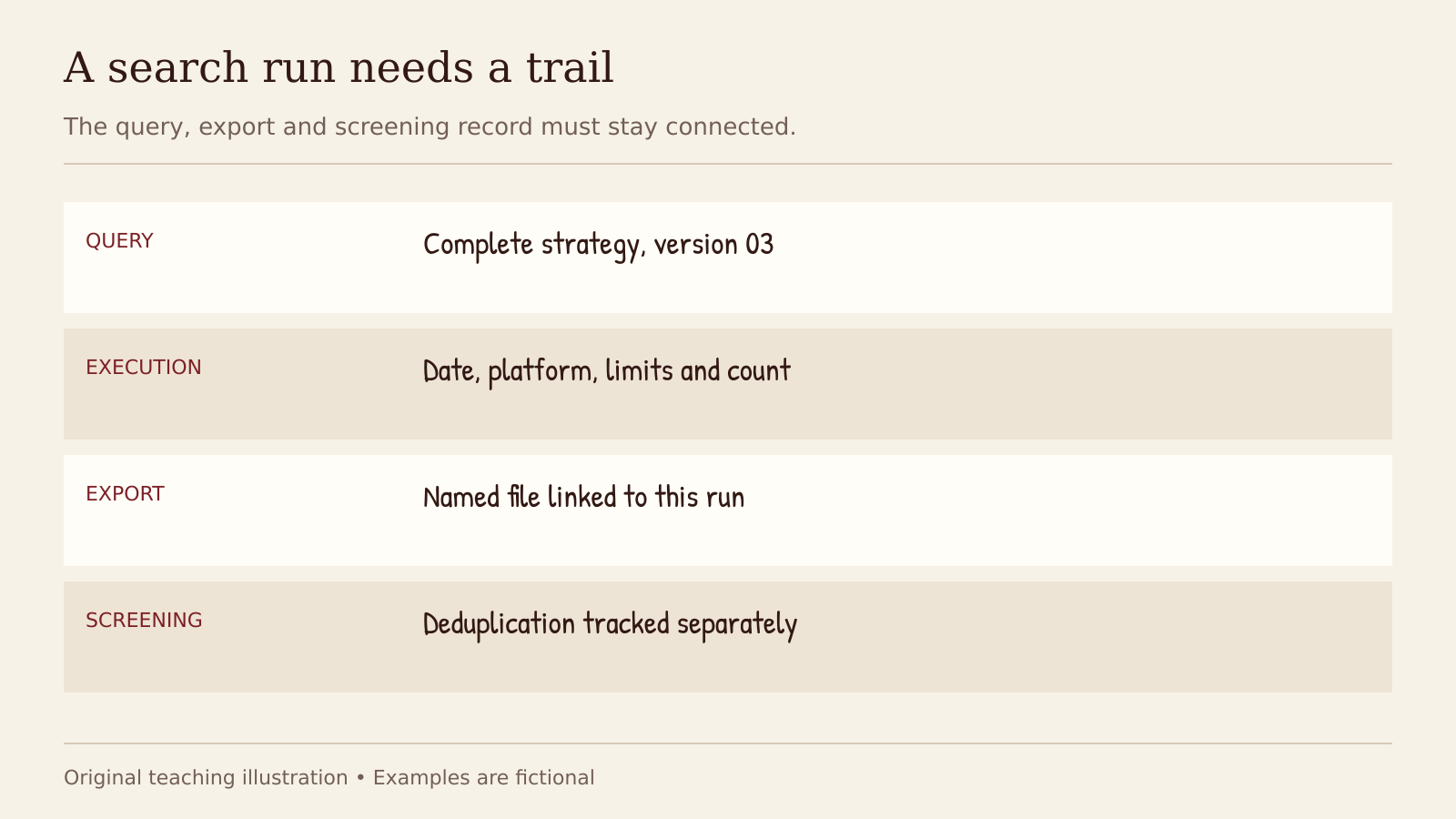
The query, export and screening record must stay connected.
The following is a fictional example; the count is invented for illustration.
| Field | Example entry |
|---|---|
| Run ID | PUBMED-03 |
| Database and platform | MEDLINE and other PubMed content, via PubMed |
| Date | 2 October 2026 |
| Query file | pubmed_strategy_v03.txt |
| Exact query | Saved in full in the linked text file |
| Limits | No language limit; date restriction justified in protocol |
| Records retrieved | 286, illustrative only |
| Export | pubmed_2026-10-02_v03.nbib |
| Reason for revision | Added a population synonym found during testing |
| Operator | Research team member identifier |
Keep long queries in plain-text files if a spreadsheet cell becomes difficult to read. The log must point to the exact saved version, not a document that is continually overwritten.
Keep different counts distinct
A search may retrieve 286 records, of which 280 export successfully. After deduplication with other searches, fewer unique records remain. Screening may later identify several reports from the same study. These numbers describe different stages.
Record the discrepancy between retrieval and export if one occurs. Investigate failed downloads or export limits before assuming six records simply disappeared. Do not label the initial result count “included studies”.
Log supplementary searching too
Database searching is not the only route to evidence. If you inspect reference lists, search a trial registry, contact authors or browse an organisation’s reports, record what you did and the relevant dates.
For a website search, note the organisation, search terms or navigation route, pages examined and stopping rule. “Searched websites” tells a reader very little. The Cochrane Handbook, Chapter 4: Searching for and selecting studies. is a useful reference for planning complementary ways to identify studies in intervention reviews.
Preserve changes without hiding mistakes
Suppose you discover that a date filter was applied accidentally. Keep the original entry, mark it superseded, explain the error and rerun the corrected search. A transparent correction is stronger than a spotless log assembled after the fact.
When updating a search, preserve the earlier run. Note whether the update covers a new date range or reruns the complete strategy. Document how newly retrieved records are compared with the existing library.
Make the log usable by a second person
Ask a colleague to locate one exact query, its export and its screening destination using only the log. If they need to message you, the record has a missing connection.
Keep the search log with the protocol, search files and review documentation, under the project’s access and backup arrangements. Avoid storing sensitive correspondence or identifiable unpublished information in a public supplement.
Copy this search-log header
Use the header below in a spreadsheet, with one row per executed search. Store the complete query in the row or link to an immutable versioned text file. The sample row earlier in this article illustrates the fields; it is not a record of an actual search.
run_id | database | platform | search_date | exact_query_or_versioned_file | limits | retrieved_n | exported_n | export_file | revision_reason | operator
Add a separate deduplication record rather than replacing the retrieved count with the number remaining after deduplication.
A good log does not prove that the search was comprehensive. It makes the search inspectable. That is the foundation for improving it—and for explaining honestly what your review did. For the next stage, explore the literature review and synthesis guides.
Continue your research
Three useful next steps for this topic.
Research notes, once a week
Practical research guidance, useful tools and funding opportunities in your inbox.