Multiple Reports of One Study: Avoid Double Counting
Learn to link multiple publications from one study, distinguish them from duplicate records and prevent double counting in a review.

Three papers do not necessarily represent three studies. A trial may produce a protocol, a primary results paper, a process evaluation and a later follow-up. Counting these as independent studies can exaggerate the apparent size of the evidence base—and counting the same participants twice can distort a quantitative synthesis.
The solution is to distinguish the record, the report and the study. A database record points to a report. A report describes some part of a study. One study can generate several reports.
In this guide
Deduplication is only the first step
Reference software can identify two database records for the same article. It usually cannot reliably determine that two different articles describe the same recruited participants.
After removing duplicate records, you therefore still need study-level linkage. The Cochrane Handbook, Chapter 5: Collecting data. discusses collecting information across reports rather than treating each publication as an independent study.
Build a study family
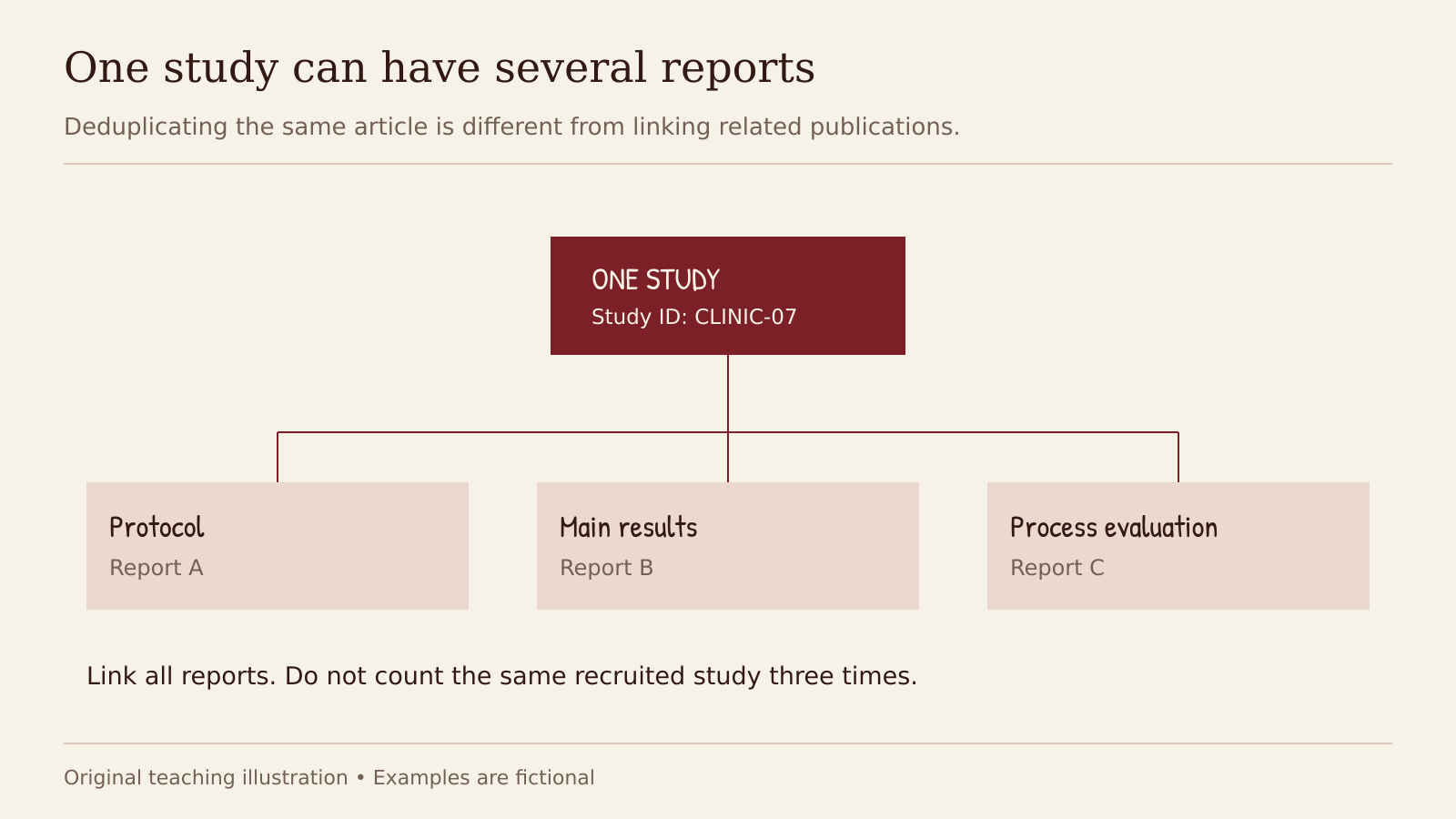
Deduplicating the same article is different from linking related publications.
Imagine a fictional programme evaluation with three publications:
| Report | Main content | Linkage decision |
|---|---|---|
| A | Protocol for 12 clinics | Assign study ID CLINIC-07 |
| B | Six-month outcomes in those clinics | Link to CLINIC-07 |
| C | Interviews with a subset of participating staff | Link to CLINIC-07; retain distinct qualitative data |
Keep all three report IDs. They may answer different review questions. Linking reports does not mean discarding everything except the largest paper.
Record the evidence supporting the link: registration number, investigators, settings, recruitment dates, intervention details, sample sizes and explicit cross-references. Similar titles or shared authors alone are not enough.
Deal with uncertainty explicitly
Suppose two papers from the same hospital report similar samples but different recruitment periods. They could describe overlapping cohorts, entirely separate studies or an expanded sample. Mark the relationship uncertain until you investigate.
Check full texts, supplements, registrations and cited earlier reports. Contact authors when justified and feasible. Preserve your reasoning even if uncertainty remains. A transparent uncertainty note is better than a confident but unsupported merge.
Decide which result answers which question
When several reports provide the same outcome and time point, use a prespecified selection rule appropriate to the review. You might prioritise a corrected final report, the relevant analysis population or the most complete outcome information.
Do not choose whichever estimate is statistically significant. If reports disagree, document the discrepancy and resolution. A correction may settle it; otherwise the uncertainty may need to appear in the review.
Different time points are not interchangeable. Six-month and twelve-month outcomes may both be useful, but must not be pooled as if they came from independent participants without an appropriate analytical method.
Keep qualitative and quantitative contributions visible
In a mixed-methods review, the outcomes paper may describe what changed while the linked interviews help explain delivery and experience. Treat their relationship as useful context, not independent corroboration from an unrelated setting.
Similarly, a secondary analysis can provide important subgroup information without increasing the number of independently recruited studies. Be precise about what is new: a report, an analysis, an outcome or a study.
Reconcile the reporting
Use the distinctions in the PRISMA 2020 flow diagram and templates. when reporting the review flow. Your included-study table can list one study with its associated reports, while the reference list still cites each publication used.
Before finalising a synthesis, sort the evidence by institution, recruitment period and registration number. Look for suspiciously familiar samples. The check is not glamorous, but neither is explaining why one cohort quietly became three.
Continue with the literature review and synthesis guides when your study families are resolved and the evidence is ready to compare.
Continue your research
Three useful next steps for this topic.
Research notes, once a week
Practical research guidance, useful tools and funding opportunities in your inbox.