How to Pilot a Qualitative Interview Guide
Pilot an interview guide for meaning, flow, depth and feasibility, then document revisions instead of treating the pilot as a rehearsal.

A pilot interview is not successful simply because the recorder worked and the conversation ended on time. Its purpose is to expose weaknesses in the guide and the interview process while there is still time to fix them.
The most useful output is therefore not “pilot completed”. It is a documented set of decisions: retain, revise, remove, reorder or investigate further.
In this guide
Decide what you are testing
Before the pilot, list the uncertainties. Do participants understand the opening question? Does the sequence make sense? Are prompts producing examples or only general opinions? Is the language appropriate? Can sensitive topics be discussed safely under the planned conditions?
Guide development includes pilot testing in the framework described by Kallio et al. Developing a framework for a qualitative semi-structured interview guide. 2016.. The specific test should reflect your participants, research question and interview context rather than an arbitrary universal number of pilot interviews.
Use conditions that resemble the real interview
If the study will use telephone interviews, a face-to-face conversation with a colleague will not test all the relevant difficulties. Consider connectivity, privacy, recording quality, language and interruptions.
Choose pilot participants who can meaningfully comment on the intended experience, subject to the study’s ethical arrangements. Colleagues can test wording and logistics, but they may understand technical language that intended participants do not.
Observe what each question produces
In a fictional service-experience study, the question “How accessible was the clinic?” produces “It was fine.” A later prompt—“Tell me about the journey you made for your last visit”—elicits transport arrangements, competing responsibilities and timing.
The lesson is not that every abstract question is wrong. It is that your opening prompt may need to begin with an event before moving to evaluation.
Use a simple review table:
| Observation | Possible explanation | Proposed change |
|---|---|---|
| Repeated requests for clarification | Wording is unfamiliar | Replace technical language and retest |
| Similar answers in two sections | Questions duplicate coverage | Merge sections, preserving useful probes |
| Detailed answers only at the end | Early questions are too closed | Move the concrete episode prompt earlier |
| Interview exceeds planned time | Too many main questions or excessive probing | Prioritise essential coverage |
Debrief without asking for polite approval
“Was everything clear?” invites a quick yes. Ask which question was hardest to answer, whether any wording felt strange, and whether an important experience had no place in the conversation.
Keep feedback distinct from substantive interview data. A participant’s suggestion about wording is not automatically a finding about the phenomenon under study.
Review the interviewer as well as the guide
Listen for interruptions, rushed transitions, leading paraphrases and missed opportunities to explore a surprising answer. A weak response may reflect how the question was delivered rather than the question itself.
If more than one interviewer is involved, compare interpretations of the guide. Agree on the purpose of each section and practise neutral follow-up. Consistency of purpose matters more than identical intonation.
Document what changed
Keep the old and new wording, the reason for the change, the date and any implications for approval or data comparability. Major changes to the topic or participant burden may require further review under your study’s arrangements.
Whether pilot data belong in the final analysis depends on consent, approvals, the extent of changes and methodological coherence. Do not automatically include them because recruitment was difficult—or exclude them without considering the design. Explain the decision.
Record the pilot decision
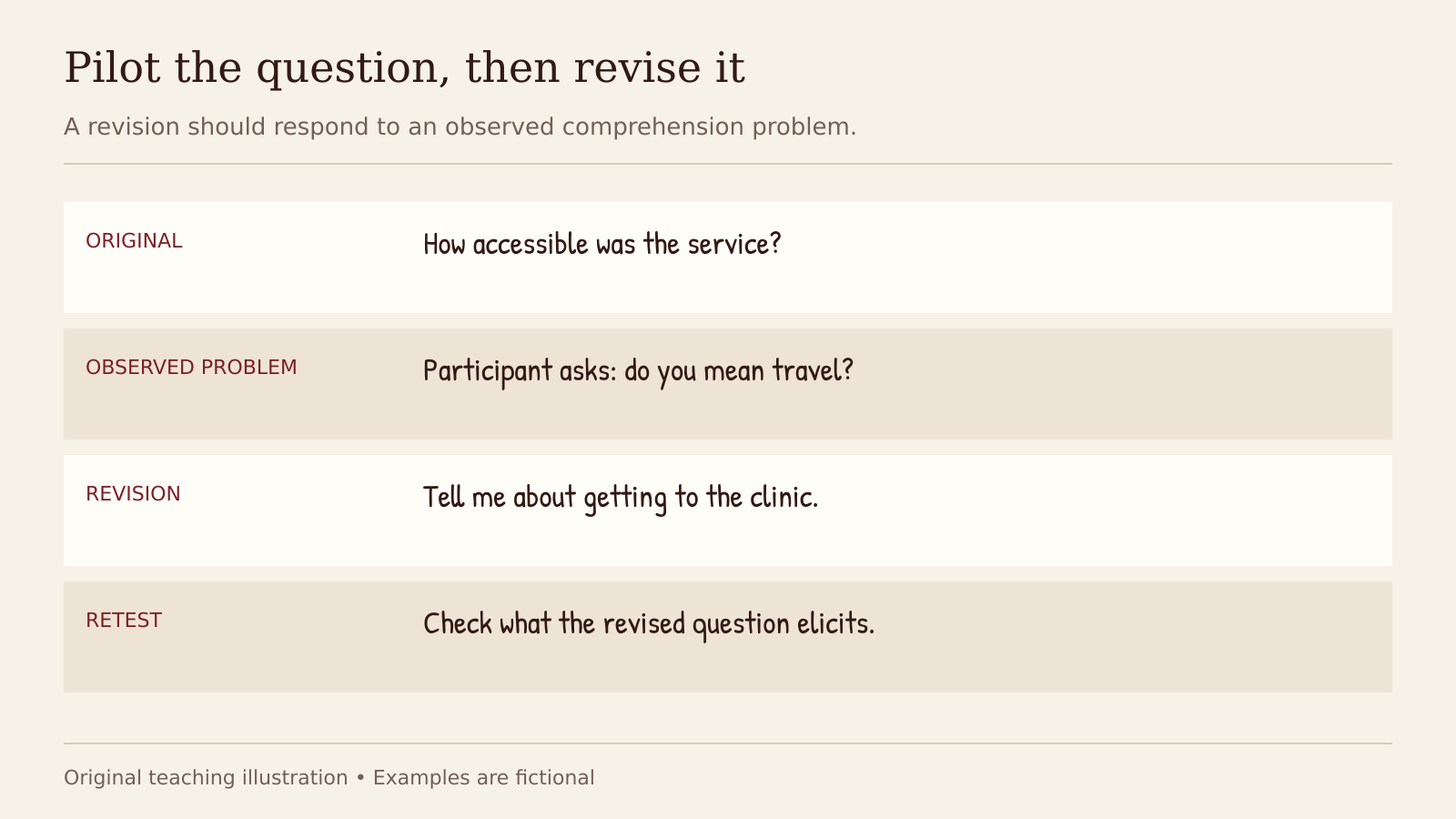
A revision should respond to an observed comprehension problem.
| Question tested | What happened | Revision to test |
|---|---|---|
| How accessible was the service? | Participant asked whether this meant travel | Tell me about getting to the clinic. |
This fictional example narrows an ambiguous question to travel. It does not cover every dimension of access: if cost, opening hours or treatment by staff matter to the research question, explore them separately. Record what prompted the change, the revised wording and what happened when it was tested again. Keep a separate note on whether the question elicited a concrete account rather than only a general opinion.
Finish by testing the revised weak points. A pilot has done its job when it improves the study, not when it confirms that the first draft was excellent. Continue with the qualitative research guides.
Use the free Methods Bench in-depth interview guide to organise topic blocks and probes, then adapt and pilot it for your own study.
Continue your research
Three useful next steps for this topic.
Research notes, once a week
Practical research guidance, useful tools and funding opportunities in your inbox.