PubMed Search Strategy: A Boolean Search Example
Build a PubMed search using concept blocks, synonyms and field tags, then test what your search retrieves and misses.

A PubMed search is not your research question with punctuation added. It is a set of decisions about which concepts must appear, how authors might describe them, and how much relevant evidence you can afford to miss.
The practical starting point is simple: use OR for alternatives within a concept, and AND to connect different concepts. Then test the search against papers you already know should be found. A plausible-looking query is not necessarily a useful one.
In this guide
Start with a question, then simplify it
Consider this fictional review question: What barriers do adolescents encounter when accessing contraceptive services in Uganda?
There are several concepts here: adolescents, contraception, access barriers and Uganda. It is tempting to insist that every record mention all four. That can be too restrictive. A relevant paper might discuss confidentiality and provider attitudes without using the word “barrier”.
Begin with three searchable concepts and decide whether the fourth is needed after inspecting results. This is an exploratory teaching example, not a validated systematic-review search.
Build the concept blocks
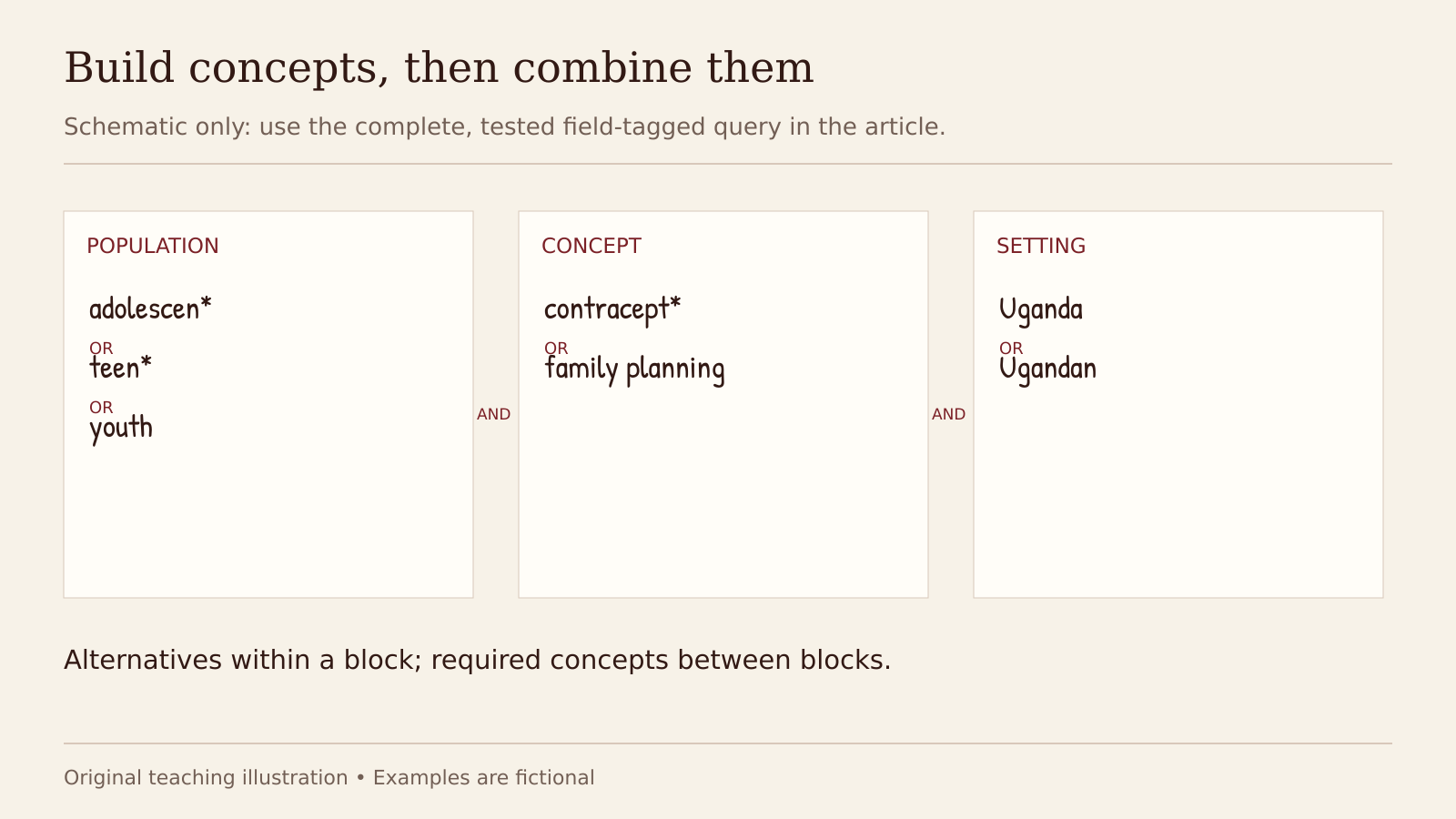
Schematic only: use the complete, tested field-tagged query in the article.
Here is a starting query using title and abstract terms:
(adolescen*[tiab] OR teen*[tiab] OR youth[tiab])
AND
(contracept*[tiab] OR "family planning"[tiab])
AND
(Uganda[tiab] OR Ugandan[tiab])
The parentheses keep each group together. The asterisk retrieves word endings, while [tiab] directs the search to the title/abstract field. PubMed has specific rules for phrases, wildcards and automatic term mapping; consult the National Library of Medicine. PubMed User Guide. when translating this example into your own strategy.
Do not assume the words in this example exhaust the topic. “Young people”, particular contraceptive methods, older terminology and relevant indexing terms may also matter. The task is to build and test coverage, not collect synonyms indefinitely.
Add indexing terms deliberately
PubMed also supports Medical Subject Headings, or MeSH. Inspect the indexing of relevant papers and check candidate headings in the MeSH database. Combine appropriate headings with free-text terms; relying only on indexing can miss recently added or otherwise unindexed records.
For each heading, ask whether it matches your concept and whether including narrower terms is appropriate. Do not paste a heading from another review simply because its title sounds similar.
Debug with known relevant papers
Choose a small set of genuinely relevant papers found through supervisors, earlier reading or reference lists. Run the search and check whether they appear.
If one is missing, examine why. Perhaps the population is described as “young women”, the location appears only in the full text, or the paper uses a specific contraceptive method rather than the broad term. Fix the concept that caused the miss. Do not automatically add every word in the missing paper.
Next, inspect irrelevant results. If most are laboratory studies or unrelated populations, check whether a term is ambiguous. Adding another AND block may reduce irrelevant records but can also remove eligible studies. Save both versions and compare what changed.
Record the actual search
Keep the complete query, database and platform, search date, limits, result count and exported file name. Search counts change over time, so a number without a date is not a reproducible record.
For a formal evidence synthesis, seek an information specialist’s review where feasible. McGowan et al. PRESS Peer Review of Electronic Search Strategies: 2015 Guideline Statement. 2016. provides a structured approach to reviewing electronic search strategies; it is not a badge a search earns merely by citing the guideline.
The final test is not “Does this query look sophisticated?” It is “Can I explain its choices, demonstrate what it retrieves, and show where its limitations remain?” Continue with the literature review and synthesis collection once your search is ready to document.
Continue your research
Three useful next steps for this topic.
Research notes, once a week
Practical research guidance, useful tools and funding opportunities in your inbox.