Semi-structured Research Interviews: Questions and Probes
Write neutral interview questions and follow-up probes that reveal experiences without supplying the answer you hope to hear.

“How did poor communication affect your experience?” sounds like an interview question. It also supplies two answers: communication was poor, and it affected the experience.
A stronger semi-structured interview guide invites participants to describe what happened before asking them to explain its meaning. Neutral questions do not remove the researcher’s interests. They make room for experiences the researcher did not predict.
In this guide
Translate the objective, not its academic wording
A research objective might be to explore organisational influences on service continuity. Asking participants about “organisational influences” may produce silence or borrowed professional language.
Begin with an experience: “Tell me about the last time you tried to arrange a follow-up visit.” Then explore people, processes, decisions and consequences within that account.
Kallio et al. Developing a framework for a qualitative semi-structured interview guide. 2016. describes guide development as a process that includes reviewing existing knowledge, drafting and pilot testing. The guide is a research instrument, not a list written the night before fieldwork.
Give every main question a job
For a fictional study of outpatient follow-up, a short guide might cover the initial visit, arranging the next appointment, events between visits, the return visit and suggestions for change.
Check whether each section contributes to the research question. Remove questions included merely because the topic is interesting. A guide that tries to study everything often leaves no time to understand anything deeply.
Use probes to clarify rather than steer
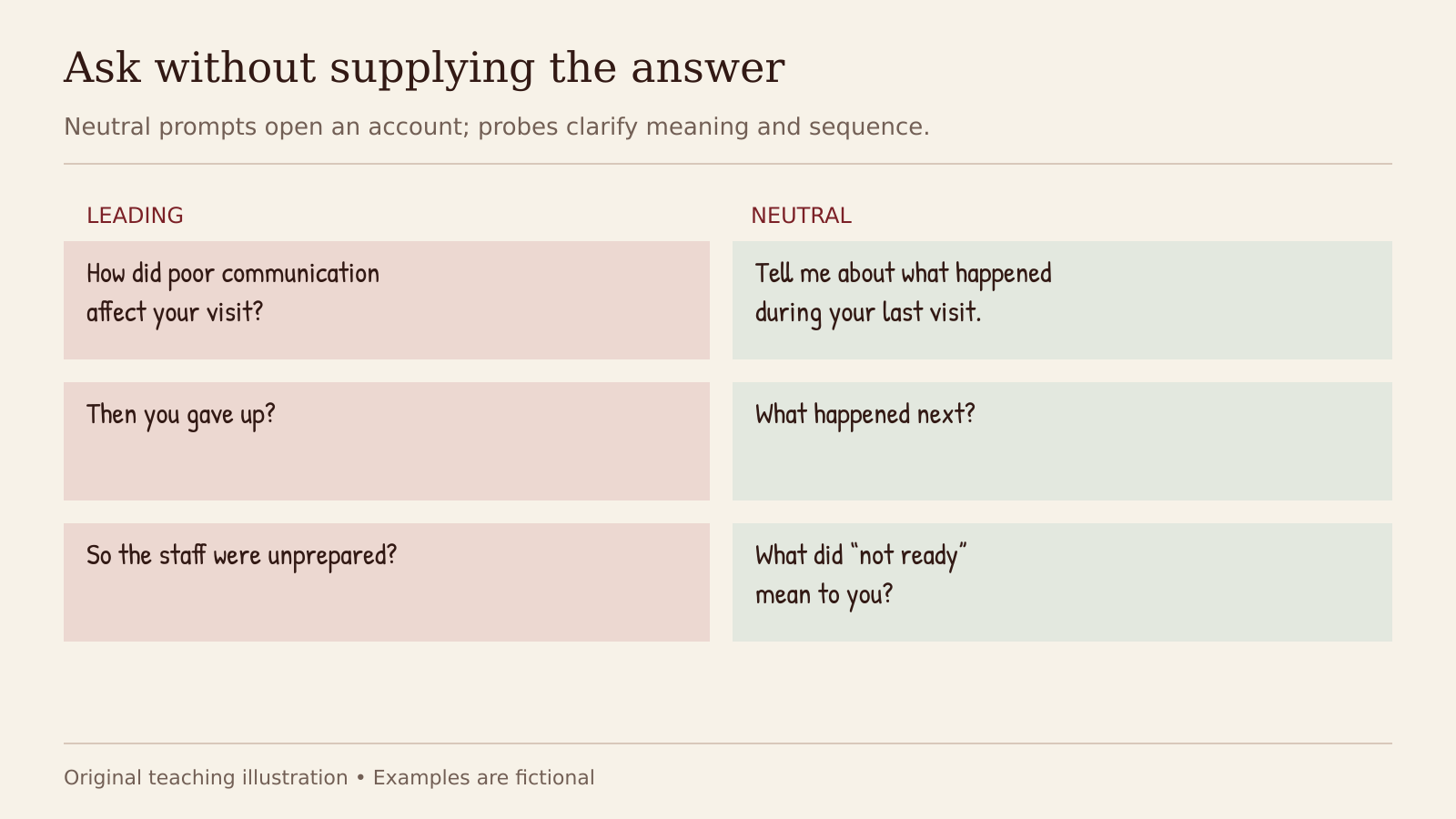
Neutral prompts open an account; probes clarify meaning and sequence.
| If you need… | Try… | Avoid… |
|---|---|---|
| A concrete episode | “Can you describe a particular occasion?” | “So this happens all the time?” |
| Sequence | “What happened next?” | “Then you gave up?” |
| Meaning | “What did ‘not ready’ mean to you?” | “You mean the staff were unprepared?” |
| Variation | “Was there a time it worked differently?” | “Was that the only good experience?” |
These are illustrative prompts, not a script to read mechanically. Follow the participant’s wording. If someone says “the process was difficult”, ask which part and what made it difficult before proposing reasons.
Separate double questions
“How did the appointment system and staff attitudes affect your decision to return?” combines two possible influences and assumes an effect. Ask about arranging the appointment first. Explore staff interactions separately if relevant.
Avoid using agreement as evidence of discovery. A participant saying “yes” to your interpretation is not equivalent to an unprompted account that supports it. Follow up respectfully, including with examples that might complicate your assumption.
Plan for sensitive moments
Sequence the guide from accessible experiences towards more sensitive topics. Remind participants that they can decline questions or stop, in line with the approved consent process. Do not promise confidentiality beyond what the study can provide.
If distress or disclosure is possible, prepare an approved response procedure and referral information where appropriate. The interview guide cannot substitute for ethical preparation or interviewer training.
Treat the guide as flexible but documented
A semi-structured interview allows responsive follow-up, not unrestricted changes to the study. Record meaningful revisions, their reasons and whether additional approval is needed. Keep the core coverage consistent enough to support the intended analysis without forcing identical conversations.
Tong, Sainsbury and Craig. COREQ: a 32-item checklist for interviews and focus groups. 2007. can help identify interview-process details that need reporting. It does not establish that an interview was thoughtful merely because every checklist box is filled.
Before using the guide, read each question aloud. Ask: Does this invite an account, contain an assumption or demand the answer I already expect? That edit often improves the data before the first interview begins. See the qualitative research collection for the next stages.
Use the free Methods Bench in-depth interview guide to organise topic blocks and probes, then adapt and pilot it for your own study.
Continue your research
Three useful next steps for this topic.
Research notes, once a week
Practical research guidance, useful tools and funding opportunities in your inbox.