How to Write Study Limitations: Examples That Explain the Impact
Replace a generic list of weaknesses with limitations that explain the affected inference, likely consequences and remaining uncertainty.

“The study had a small sample and used self-reported data” identifies two features. It does not explain what they mean for the findings.
A useful limitations section connects a problem to the inference it affects. It tells readers what may be uncertain, distorted or restricted—and what the study can still reasonably contribute. The aim is neither self-defence nor self-demolition.
In this guide
Use a four-part structure
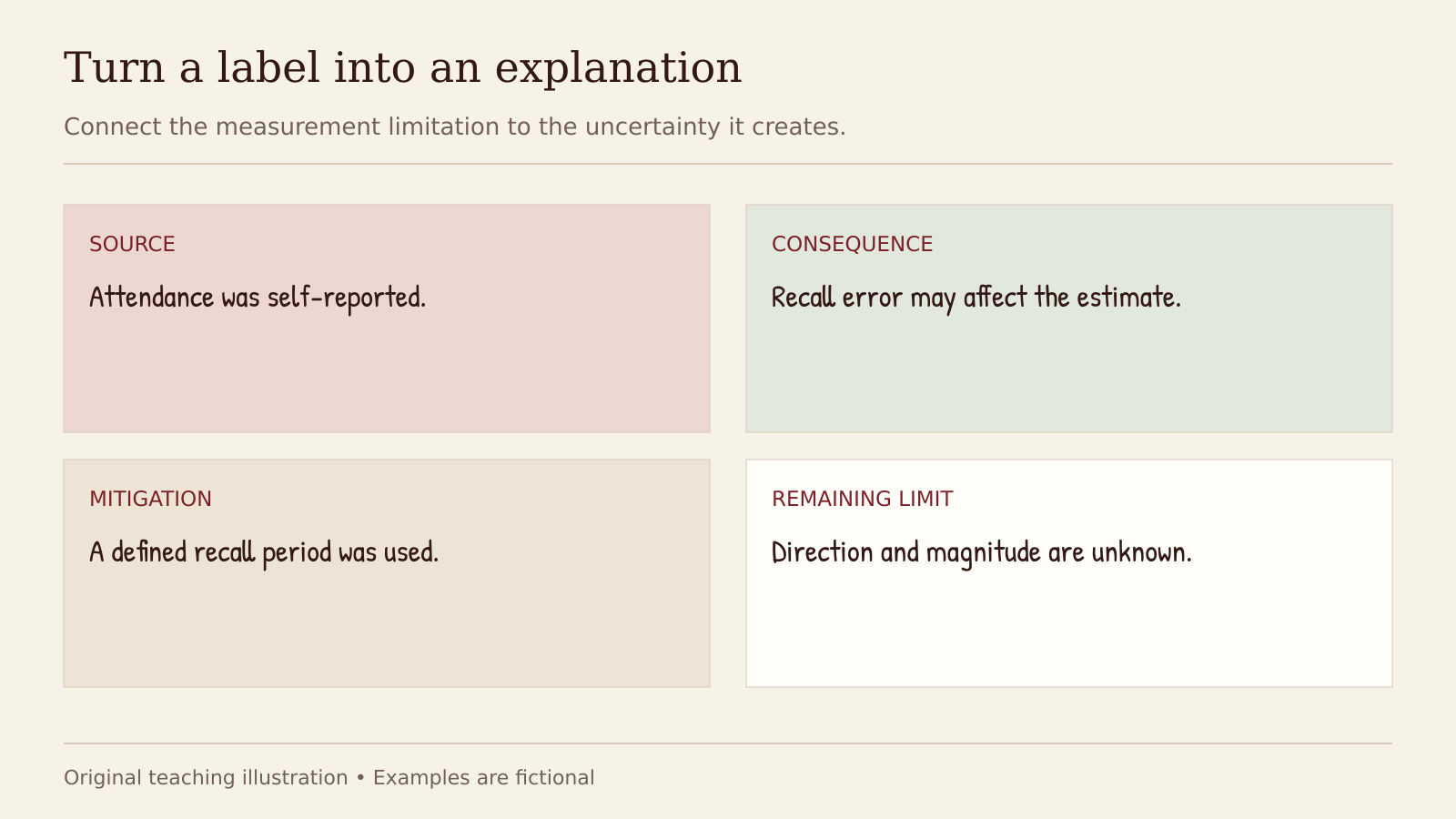
Connect the measurement limitation to the uncertainty it creates.
For each important limitation, identify the source of the problem, the affected result or inference, the plausible consequence and any mitigation or remaining uncertainty.
For a fictional appointment study: “Attendance was reported by participants rather than verified against clinic records. Recall errors may therefore have affected the estimated attendance proportion. We used a defined recall period, but could not establish the direction or magnitude of any error.”
The sentence does not pretend that a short recall period eliminates measurement error. It also avoids claiming a direction of bias without evidence.
Be specific about sample size
A small sample may produce imprecise estimates, limit subgroup analysis or fail to capture relevant variation. Those are different consequences.
Instead of “the sample was small”, write what the sample size prevented you from estimating or examining. If the confidence interval is wide, discuss the range of plausible effects rather than equating a non-significant result with no effect.
For qualitative research, do not import a quantitative representativeness argument automatically. Discuss the depth, scope, diversity and methodological purpose of the sample in terms appropriate to the study.
Separate selection from generalisability
If participants were recruited from one clinic, the relevance to other settings may be limited. If attendance at recruitment was related to both the exposure and outcome, there may also be a selection problem within the study’s association estimate.
These are not interchangeable statements. Explain who was not represented and why that omission matters for the question. “The findings may not be generalisable” is usually the beginning of the explanation, not its end.
Avoid invented directions of bias
Researchers often write that social desirability “overestimated” a favourable behaviour without considering how the question, setting and relationships may have influenced reporting. A direction may be plausible, but should be justified and qualified.
Where the direction is unknown, say so. Where sensitivity analyses or external information help assess the effect, explain what they show and what they cannot resolve.
The STROBE. Checklist for cross-sectional studies. asks observational-study authors to discuss limitations, including potential bias and imprecision. This is a reasoning task, not merely a requirement to include a paragraph labelled “Limitations”.
Do not oversell mitigation
Training interviewers, using an established questionnaire or adjusting a model can address some problems. None automatically removes all measurement error, confounding or selection bias.
State what was done and the residual issue. “We adjusted for measured covariates, but unmeasured and imperfectly measured confounding may remain” is more defensible than “confounding was controlled” when the latter implies elimination.
End with the contribution that remains
Limitations should shape the conclusion. If the design cannot establish causation, avoid causal recommendations disguised as practical implications. If the setting is narrow, identify the contexts to which the findings may be informative rather than claiming universal application.
The ICMJE. Preparing a Manuscript for Submission to a Medical Journal. supports discussion of limitations and appropriately bounded conclusions in medical manuscripts. Journal and discipline requirements may differ, so check the relevant instructions as well.
Before submission, underline the consequence in each limitations sentence. If there is nothing to underline, you probably have a label rather than an explanation. Continue with the manuscript and publication collection to align the discussion and conclusion.
Continue your research
Three useful next steps for this topic.
Research notes, once a week
Practical research guidance, useful tools and funding opportunities in your inbox.